• Skip to primary navigation
  • Skip to main content
  • Skip to primary sidebar
Japan Distilled logo in black.

Japan Distilled

Home of the Japan Distilled Podcast

  • Home
  • Podcast Episodes
  • About Us
  • Contact Us
  • Show Search
Hide Search

Podcast

Spirits Dilution is Underrated (Ep. 54)

March 3, 2023 · Leave a Comment

INTRO

In episode 54 of the Japan Distilled podcast, we discuss something that is almost never talked about in spirits. Dilution. Nearly all distilled beverage alcohol has water added before bottling. Why is that? And why is it so incredibly important in Japan?

CREDITS

Theme Song: Begin Anywhere by Tomoko Miyata (http://tomokomiyata.net/)

Mixing and Editing: Rich Pav (https://www.uncannyrobotpodcast.com/)

HOSTS

CHRISTOPHER PELLEGRINI Vermont born and bred, long-time Tokyo resident and author of The Shochu Handbook, Christopher learned about delicious fermentations as a beer brewer at Otter Creek (Middlebury, VT). He now spends most of his waking hours convincing strangers that shochu and awamori are unlike anything they’ve ever tried before. 

STEPHEN LYMAN discovered Japan’s indigenous spirits at an izakaya in New York City. He was so enthralled that he now lives in Japan and works in a tiny craft shochu distillery every autumn. His first book, The Complete Guide to Japanese Drinks, was nominated for a 2020 James Beard Award.

Stephen and Christopher are almost as geeky about Japanese water as they are about Japanese spirits.

If you have any comments or questions about this episode, please reach out to Stephen or Christopher via Twitter. We would love to hear from you. 

SHOW NOTES

Water

It’s not too much to say that water is the key to life. Without it, we would not exist. We could not survive. Of course, this is true of many other minerals, vitamins, and molecules, but water is fundamental.

spirits dilution
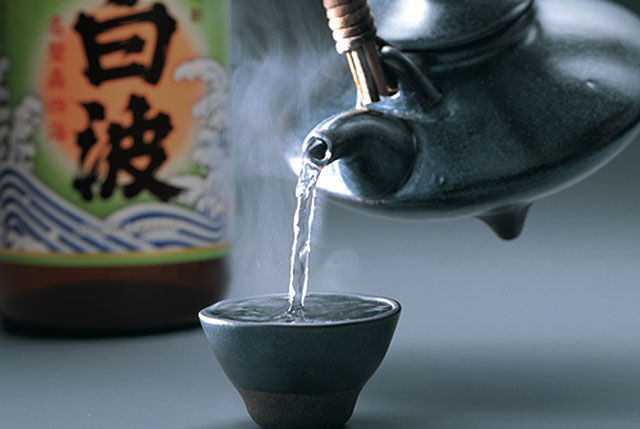
water and shochu, a perfect match.

Historically, water near population centers was dangerous – not fit for drinking but for risk of disease or even death. In Medieval Europe beer and wine were safer than water for drinking. Alcohol kills all kinds of bacteria and viruses that might otherwise do us harm.

But pure water is truly the elixir of life. Water out in nature, up in the mountains, out in the forests, away from people and animals and their stink became a prized commodity. A luxury good.

Water Hardness

Today most municipal water in developed countries is clean and fit for bathing or even drinking. But something that still differentiates modern water sources is the water hardness. Water hardness is defined primarily by the mineral content and that is determined largely by how long it takes the water to run through the soil and rock to the underground springs as well as what kind of rock it runs through.

American water tends to be moderately hard while European water is quite hard. Evian, a famed water source, is not soft water at all despite its excellent drinkability.

Meanwhile, in Japan

On the other hand, Japanese water tends to be very soft by Western standards. Japan emerged from the Ring of Fire in the recent past (geologically speaking) so the water run off from rainfall is relatively fast and the rocks it passes through does not provide a lot of minerality. This is a very long way of saying that Japanese water is very soft and, in our opinion, perfect for spirits dilution.

Spirits Dilution

Until the recent obsession with “barrel proof” or “cask strength” whiskies, spirits dilution was the standard in virtually every spirits tradition. Vodka, which if made in a column still, is 95% alcohol or higher before being diluted back down to 40 to 50% so at least half that bottle is water that has been added back in.

As a consumer, that may feel like cheating, but that could not be further from the truth. When alcohol is distilled, the water that carries over into the distilled spirit is also distilled. As a result, it’s lost all of the minerality and texture and mouth feel and even flavor that existed before distillation. With spirits dilution, all of that is reintroduced to the drink. Dilution is a good thing!

What do you think?

We realized spirits dilution and water quality generally may not be a great topic for a podcast, but we hope we’ve entertained you.

Kanpai!

The Improbable Journey of Jokichi Takamine, Pt 2 (Ep. 53)

February 16, 2023 · Leave a Comment

EPISODE INTRO

In the 53rd episode of the Japan Distilled podcast, we complete Jokichi Takamine’s improbable journey and reflect on his legacy. This is the 2nd in a 2 part series so if you missed episode 52, we recommend you go back and have a listen about Jokichi Takamine’s formative years.

CREDITS

Theme Song: Begin Anywhere by Tomoko Miyata (http://tomokomiyata.net/)

Mixing and Editing: Rich Pav (https://www.uncannyjapan.com/)

HOSTS

STEPHEN LYMAN discovered Japan’s indigenous spirits at an izakaya in New York City. He was so enthralled that he now lives in Japan and works in a tiny craft shochu distillery every autumn. His first book, The Complete Guide to Japanese Drinks, was nominated for a 2020 James Beard Award.

MATT ALT is our first guest host! Author of numerous books including his most recent, Pure Invention: How Japan Made the Modern World, is an exploration of Japan’s incredible post-war rise to commercial diplomacy juggernaut. He’s also an accomplished drinks writer and cocktail historian.

If you have any comments or questions about Jokichi Takamine, please reach out to Stephen or Matt via Twitter. We would love to hear from you. 

SHOW NOTES

Immigrating to the US

In 1890, at the behest of his mother-in-law and to the relief of his wife Caroline, Jokichi Takamine moved his family to Chicago, Illinois where he established the Takamine Ferment Company.

Illinois Whisky Trust

Takamine Koji Whiskey

By 1891, Jokichi Takamine had patented the use of koji for alcohol production in both the US and UK. In the same year, he licensed his US patent to the Illinois Whisky Trust, the largest producer of distilled spirits in America in the late 19th century.

The Chicago Tribune ran an article claiming that whisky was to become cheaper thanks to the proprietary Takamine Process. Exactly two weeks later, there was a mysterious fire at the Manhattan Distillery in Peoria, IL, where the koji whiskey experiments were underway. Not dissuaded, the distillery was repaired and experiments continued until commercial production was greenlit in December 1894.

Sadly, in February 1895, the State of Illinois and Justice Department enforced the Sherman Act to break up the Illinois Whisky Trust. The new owners of the Manhattan Distillery reverted to malting. Dr. Takamine sued in federal court to get his patent back, but he lost – the patent was considered an asset sold to the new owners.

A New Start

Health problems and potential backlash toward him and his family resulted in Jokichi Takamine moving with his family to New York City in 1897. By 1900 he had isolated adrenaline in his Harlem laboratory. This coupled with his previously patented Taka Diastase digestive aid had made him and his family very wealthy.

Taka Diastase digestive aid.

He’d gained notoriety back in Japan as well so when the St. Louis World’s Fair concluded, the emperor gave the Japan Pavilion structure to Takamine. This was a replica of one of the emperor’s summer palace, which Takamine moved by rail to the Catskills in Upstate New York where it was renamed Shofuden. Today it’s being renovated by private owners. Their Instagram is wonderful.

Caroline and Jokichi at Shofuden in Forestburgh, NY

Later Years

Dr. Takamine would spend the remainder of his life focused on philanthropy and attempting to help bridge American Japanese relations. He founded the Nippon Club, a private gentleman’s club in NYC for Japanese businessmen. It’s still active today.

Dr. Takamine’s cherry trees bring joy even today.

And in perhaps his greatest contribution to American culture, he donated the cherry trees that ring the Tidal Basin in Washington, DC, as well as trees in Baltimore, MD, and New York City.

Takamine’s Grave in Woodlawn Cemetery, The Bronx, NY.

Sadly, he would die relatively young on July 22, 1922 at the age of 67. He is interred in his mausoleum in Woodlawn Cemetery in the Bronx.

Legacy

Dr. Takamine remains a giant in his own right. The first person to isolate a human hormone, the first Japanese person to make whisky, the donation of the cherry trees to the US, founding a still existent pharmaceutical company in Japan, and establishing a gentlemen’s club that is still active over 100 years later.

Sadly, his son Jokichi, Jr., passed unexpectedly under mysterious circumstances in his early 40s and Ebenezer struggled to keep the family business afloat. He was finally granted American citizenship just a couple years before he died. Caroline would remarry, but when she died in her 80s, she was laid to rest beside Jokichi Takamine.

Jokichi, Caroline, and Jokichi, Jr.

Of course, he is gone, but not forgotten. His koji whiskey lives on in Takamine Whiskey from the Shinozaki Distillery in Fukuoka, Japan, imported to the US by Honkaku Spirits. Available at fine retailers in many states.

KANPAI!

The Improbable Journey of Jokichi Takamine, Pt. 1 (Ep. 52)

February 3, 2023 · Leave a Comment

EPISODE INTRO

In the 52nd episode of the Japan Distilled podcast, we take you through the foundational years of the improbable and remarkable journey of the first Japanese person to ever make whiskey: Jokichi Takamine. It’s probably not too much to say that Jokichi Takamine is the most important Japanese immigrant to ever live in the United States. His whiskey is just a small part of his story.

CREDITS

Theme Song: Begin Anywhere by Tomoko Miyata (http://tomokomiyata.net/)

Mixing and Editing: Rich Pav (https://www.uncannyjapan.com/)

HOSTS

STEPHEN LYMAN discovered Japan’s indigenous spirits at an izakaya in New York City. He was so enthralled that he now lives in Japan and works in a tiny craft shochu distillery every autumn. His first book, The Complete Guide to Japanese Drinks, was nominated for a 2020 James Beard Award.

MATT ALT is our first guest host! Author of numerous books including his most recent, Pure Invention: How Japan Made the Modern World, is an exploration of Japan’s incredible post-war rise to commercial diplomacy juggernaut. He’s also an accomplished drinks writer and cocktail historian.

If you have any comments or questions about Jokichi Takamine, please reach out to Stephen or Matt via Twitter. We would love to hear from you. 

SHOW NOTES

Upheaval

The mid-1800s brought incredibly fast change to Japan as the US opened the country at gunpoint and the shogunate collapsed. Jokcihi Takamine and others like him were born into and grew up in this turbulent time. For many this lead to radicalization and extreme violence. For others, like Jokichi, this lead to opportunities uinmaginable just a few years earlier.

Early Years

Born November 3, 1854 to a samurai physician and the daughter of a sake making family, Jokichi Takamine was the first of 13 children.

Jokichi and his Father

He’d quickly be recognized as a prodigy by the Kaga Domain leaders, who supported his educational journey from Nagasaki to Kyoto to Osaka and ultimately to Tokyo University where he would be part of the 1st graduating class of the School of Engineering with a degree in applied chemistry. He would then, like so many others, be sent abroad to study western industrial practices.

Early Career

As with many young men of this era, Jokichi Takamine went to work for the central goverment in Tokyo, assigned to the Department of Agriculture and Commerce where he is tasked with modernizing 3 key Japanese industries: indigo dye production, paper-making, and of course, sake brewing. Before long he would be assigned to join a delegation to the World’s Exposition in New Orleans where he would be welcomed as a visiting dignitary (Americans saw the samurai class as knights and though he’d officially lost his title, this didn’t seem to matter).

Jokichi Takamine as a young man.

While in New Orleans, Jokichi Takamine would meet and fall in love with a young debutante, Caroline “Carrie” Hitch. Lacking the resources to ask for her hand in marriage, he returned to Japan to earn enough to marry her.

Jokichi and Caroline were an unlikely pair for the time, but they would remain together until his death.

Upon his return, was assigned as the interim director of Japan’s patent office. Shortly thereafter he took leave of the post to establish Asia’s first superphosphate mine. Fortunate secured, he returned to New Orleans in 1887 to marry Caroline.

Tokyo

Caroline gamely moved to Tokyo with her new husband, but the culture shock appears to have been too much.

Ebenezer, Jokichi, and Jr.

She did manage to bear two children during their brief stay in Tokyo, Jokichi, Jr. and Ebenezer. Just 3 years later, the family would be encouraged to return to America by Caroline’s mother who had a business proposition. But that will have to wait until next time.

KANPAI!

A Year of Drinking Less Dangerously (Ep. 51)

January 17, 2023 · Leave a Comment

INTRO

In our 51st episode we take stock of things and decide to reflect on the effects alcohol has on our bodies while contemplating ways of drinking less to more safely enjoy these drinks we know and love.

CREDITS

Theme Song: Begin Anywhere by Tomoko Miyata (http://tomokomiyata.net/)

Mixing and Editing and Interrogator: Rich Pav (https://www.uncannyrobotpodcast.com/)

HOSTS

CHRISTOPHER PELLEGRINI Vermont born and bred, long-time Tokyo resident and author of The Shochu Handbook, Christopher learned about delicious fermentations as a beer brewer at Otter Creek (Middlebury, VT). He now spends most of his waking hours convincing strangers that shochu and awamori are unlike anything they’ve ever tried before. 

STEPHEN LYMAN discovered Japan’s indigenous spirits at an izakaya in New York City. He was so enthralled that he now lives in Japan and works in a tiny craft shochu distillery every autumn. His first book, The Complete Guide to Japanese Drinks, was nominated for a 2020 James Beard Award.

Stephen and Christopher are constantly aware of the risks of being professional drinkers.

If you have any comments or questions about this episode, please reach out to Stephen or Christopher via Twitter. We would love to hear from you. 

SHOW NOTES

Should start this off by recommending Adam Rogers’ excellent Proof. A fantastic book about the science of alcohol from production to hangovers.

Alcohol Effects

Immediate Effects: When you start drinking, alcohol goes straight to your head and begins altering yours experience nearly immediately. Ethanol blocks glutamate and GABA receptors, which creates a sense of calm and releases powerful doses of serotonin and dopamine. You’re essentially getting an artificial dose of opiates that your body creates naturally.

Very quickly, you sensory perception alters and you begin having changes in emotions and other mental activities. As this is happening, the liver begins working on the alcohol, which it considers a toxin. The alcohol is broken into acetaldehyde, which is a very dangerous compound. A healthy liver can further break the acetaldehyde down into harmless byproducts, but that’s only the case in relatively healthy people.

Once you get deeper into your cups, you begin to lose motor control, memory, and other physical and mental capacity, which results in imbalance and potential for injury.

And, of course, we’ve all heard of the happy drunk, angry drunk, or sad drunk. Alcohol creates an artificial emotional response and can heighten emotions we already have. All of this is a potential recipe for violence or self harm if the drinking goes too far.

Hangovers: Unfortunately, there is no clear understanding of why hangovers occur or how to treat them. There are plenty of theories about both, but so far we do not have good answers despite hangovers accounting for billions of dollars in lost productivity every year in the US alone.

Alcohol Dependence: As the body becomes accustomed to the dopamine and serotonin it receives as a reward for drinking, it needs more alcohol to get the same feeling. This leads to a cascade of increased consumption that can lead to heavy drinking or even addiction.

Long-term Effects: Heavy alcohol consumption can lead to a wide variety of diseases ranging from cancer to heart disease to cirrhosis of the liver. Many of these are irreversible and potentially fatal.

Drinking Mindfully

People’s relationship with alcohol can perhaps be classified broadly into these categories:

Never Drinkers – self explanatory.

Infrequent Drinkers – people who only partake rarely.

Social Drinkers – people who drink in social situations, but tend not to indulge otherwise.

Regular Drinkers – people who enjoy alcohol independently whether socializing or not.

Problem Drinkers – people who have moved into the danger zone of dependence and over-indulgence.

The borderline between healthy and unhealthy likely lies between regular and problem drinkers, though of course, regular drinkers may suffer some of the same long-term health effects as problem drinkers.

If you’re looking for ways to be more mindful in your drinking, here are a few potential strategies.

  1. Count your drinks – simply being aware can be useful. Stephen uses Reframe.
  2. Hydrate – water or rehydration drinks like Gatorade.
  3. Eat while drinking – fills your stomach and give the body nutrients.
  4. Education – learn about the effects of alcohol on your body. Reframe can help here too.
  5. Take a day off now and again.
  6. Quit for a week or so every so often to check on yourself.

How Japanese Spirits Can Help

Drinking Less
Maewari shochu in a kuro joka for communal service.

No alcohol consumption can be considered a healthy behavior, but if you are going to enjoy drinking, you may as well try to minimize its negative effects. Japanese drinking customs can help with that.

  1. Japanese drinks are almost always accompanied with food. Embrace that.
  2. Shochu is almost always consumed with dilution. That can help reduce intake.
  3. Communal service – sharing a carafe of shochu or awamori will make you drink more slowly than going by the glass.
  4. Vacuum distilled shochu lacks many of the congeners that are believed to be responsible for hangovers.
  5. KyuKanbi – take a regular day (or days) off from drinking.

Kanpai!

Our First Ever Spirits Q&A (Ep. 50)

December 30, 2022 · Leave a Comment

INTRO

In 50th episode we have a little spirits Q&A fun with our hosts answering listener questions about topics ranging from underrated distilleries to Casper the Friendly Ghost.

CREDITS

Intro: Theresa Matsuura of the Uncanny Japan Podcast.

Theme Song: Begin Anywhere by Tomoko Miyata (http://tomokomiyata.net/)

Mixing and Editing and Interrogator: Rich Pav (https://www.uncannyrobotpodcast.com/)

HOSTS

CHRISTOPHER PELLEGRINI Vermont born and bred, long-time Tokyo resident and author of The Shochu Handbook, Christopher learned about delicious fermentations as a beer brewer at Otter Creek (Middlebury, VT). He now spends most of his waking hours convincing strangers that shochu and awamori are unlike anything they’ve ever tried before. 

STEPHEN LYMAN discovered Japan’s indigenous spirits at an izakaya in New York City. He was so enthralled that he now lives in Japan and works in a tiny craft shochu distillery every autumn. His first book, The Complete Guide to Japanese Drinks, was nominated for a 2020 James Beard Award.

Stephen and Christopher enjoy fielding questions about their favorite drinks and just about anything else.

If you have any comments or questions about this episode, please reach out to Stephen or Christopher via Twitter. We would love to hear from you. 

SHOW NOTES

The Spirits Q&A Questions

GHOSTLY SPIRITS Q&A: 

Sakamichi Brewing: What’s your favourite Yōkai?

Joe from the Ishikawa Summit to Sea Podcast: Which spirit is better, shochu, or Casper the friendly ghost? 

DISTILLED SPIRITS Q&A:

Casey from the Beanpod Podcast: What’s your ‘holy grail’ of booze? 

Casey again: If you could only drink one alcoholic beverage for the rest of your life, what would it be? 

Craig Hoffman: Is there really that much difference in taste based on price, especially in the mid-range and mid-quality spirits in Japan? I feel I have often overpaid for some over the years.

Coffee or Shochu: For those traveling to Japan, are there any domestic / rare export bottles you would recommend to buy and bring home? We can assume space for only one or two bottles in a suitcase. It could be anything (shochu, whisky, rum, etc.)

Davey in Japan: What is the Goto drink on the shinkansen? I maintain beer but sake cups, chuhai, high balls, or drinking straight from the bottle all have their justifications.

SHOCHU/AWAMORI FOCUSED:

Ben Harris: If could only drink one shochu/awamori for the rest of your life what would it be? 

Joe from the Ishikawa Summit to Sea Podcast: Imagine you were buying a gift of shochu for someone who has never been to Japan and might not be used to the unique taste, what would you buy them and why?

Hakata Rick: In the way that fine wines are often paired with a certain kind of meal, would/could the same apply to shochu? If so, what are some of your personal favorites?

Ben Harris: In your opinion, what is the most underrated shochu/awamori distillery?

Sake Enthusiast: 

  1. Where should someone interested in shochu get started? Like someone living in the southern US who likes whiskey and bourbon. What advice would you give them to get their shochu journey started and what should they drink first.
  1. whats your end of year furusato nozei recommendations for shochu this year? 

Armando Cornejo: Do you think there will be a proposal from the industry to abolish the no-color rule for shochu?

Daniel Avispa: Is it ok to mix shochu with a flavored soda to have as sodawari? E.g. a good quality lemonade, or are we heading into chuhai territory? (of course, its down to personal taste, but interested in your thoughts).

CHUHAI QUESTION: 

Greg Beck: How did canned Chu-hi start and why didn’t they come to the states to compete with inferior “hard seltzer”?!?

Note: we did not answer the 1st part of that. For how canned chu-hai started, please refer to our Chuhai Episode (episode 25), where we get into that history.

RUM ?

Daniel Morales: What rum do you recommend for winter cocktails?

WHISKY ?

Renee Lang: I remember drinking Suntory, but I don’t remember which was most single malt Scotch-like. Is it the Toki? 

OTHER DRINKS QUESTIONS: 

Casey from The Beanpod Podcast: What beer(s) have stood out in the past year of your running/beer catalogue? 

Tavis Allen: Climate change and the spirits industry—Japan, globally—what are peoples’ thoughts/actions on the matter?

Michael Brock: have any peer-reviewed studies been done on this ヘパリーゼ  stuff?

Chris Pearce (comment, not a question): Bourbon is the holy grail of booze. Thoughts? 

Personal Questions: 

Craig Fisher: You eat that?!

Tavis Allen: 

Your Yamatozakura “internship”—how’d you get started? Do you know how many other foreigners are similarly involved in making spirits in Japan? How can one get involved?

What do your families—immediate and extended—think about what you do? What do they drink?

Anagman: would either of you update your book with a new edition, and if so, how? 

Jeff Cioletti: I want to put an Ocean’s 11 team together to steal the Satsuma Kiriko Christmas Tree outside Kagoshima Chuo Station. You in?

Random Brands Recommended on the Spirits Q&A

Japanese whisky service styles
Komagatake Limited Edition
Ozusu Gin
BeniSango Barrel Aged Kokuto Shochu
Manazuru
iichiko
Mushagaeshi
Rurikakesu Japanese rum
Rurikakesu Rum
Nine Leaves Japanese rum
Nine Leaves Rum
spirits Q&A

Keep them Coming

We enjoy your Spirits Q&A questions, so please keep on asking and we’ll keep on answering.

Kanpai!

  • « Go to Previous Page
  • Page 1
  • Interim pages omitted …
  • Page 7
  • Page 8
  • Page 9
  • Page 10
  • Page 11
  • Interim pages omitted …
  • Page 19
  • Go to Next Page »

Primary Sidebar

Never miss a new episode. Subscribe now

Japan Distilled

Copyright © 2026 · Log in