EPISODE INTRO
In the 34th episode of the Japan Distilled podcast, your host Stephen Lyman takes you on an auditory journey, working the morning shift in a handmade shochu distillery. This is a pretty sharp departure from our usual Japan Distilled podcast as we enlist the voice over assistance of our editor Rich Pav who also incorporated all of the music and sound effects. This is part 1 in a planned 3 part series encompassing a day in the life of a shochu distillery.
THE MORNING SHIFT HOST
STEPHEN LYMAN discovered Japan’s indigenous spirits at an izakaya in New York City. He was so enthralled that he now lives in Japan and works in a tiny craft shochu distillery every autumn. His first book, The Complete Guide to Japanese Drinks, was nominated for a 2020 James Beard Award.
Stephen has been writing professionally for over two decades, but this is his first attempt at writing a narrative audio story. He stared working at Yamatozakura Distillery in October 2013 and has worked dozens of morning shifts at this point.
If you have any comments or questions about this morning shift episode, please reach out to Stephen or Christopher via Twitter. We would love to hear from you.
THE MORNING SHIFT SHOW NOTES
The Morning Shift Transcript
The Morning Shift
My iPhone alarm (“Radar”) shocks me awake. Really need to remember to switch it to something less jolting. At first I am unsure where I am. I sense I’m in a futon, sleeping on a tatami mat. This is not where I usually sleep. Even though I’ve moved to Japan I still sleep on a mattress. The dark windows tell me it’s not even dawn. I move to hit snooze, but remember where I am and why it’s so early. I’m not an early riser. In fact, I am an incurable night owl. I was furtively reading books with a flashlight until the early hours since before I was old enough to go to school on my own. But here I am, throwing aside the blanket and turning off my alarm as I fumble for the pull string for the overhead light. It thankfully illuminates dimly, just as I had left it to relax before sleeping the night before. Rubbing the sleep from my eyes, I stretch and feel every muscle in my body groaning. I’m sore. Everywhere.
I pull on the clothes I laid out the night before to save me time this morning. Stumble out of the bedroom and down the stairs to the bathroom. Wash my face with ice cold water. Brush my teeth. Run my fingers through my bedhead to try to look more presentable. Need to remember to cut my hair short before the season starts next year. A canned black coffee waits for me in the fridge. At home I would normally pair my coffee with natto – fermented soy beans – but that’s off limits here. The strong natto bacteria could destroy the delicate fermentation we’ve worked so hard to create. Three weeks of work could be wrecked. No natto until I get home.
I hear a car pull up on the gravel outside. I know it’s time to get started as the metal storm shutters to the office rumble open from the outside. The morning shift is starting. I slide into my Vans waiting in the foyer, and head outside, coffee in hand. Even though we’re nearly as far south as you can go and still be in Japan proper, there’s a chill in the air. A slight breeze brings the unmistakable scent of the East China Sea, less than a kilometer away. It also makes it just that much colder.
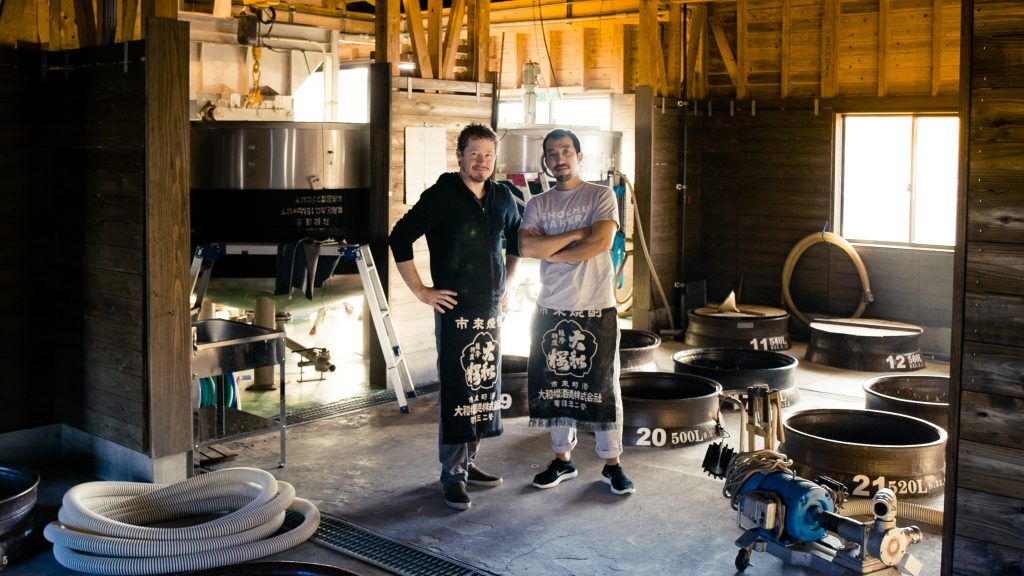
There’s Tekkan, my constant companion, opening the last shutter in the shadows. He smiles when he sees me and gives me a quick Ohayo, which sounds an awful lot like Ohio, but means good morning in Japanese. I give him a bleary reply. He’s a decade older than when I first met him. A bit less hair, but the same infectious smile and enthusiasm for seemingly everything. He’s wearing Nike running gear as usual, and Montbell down vest against the cold. His Mets cap on backward. He’d bought it when he visited me in New York City years ago.
He looks as tired as I feel. He was no doubt up at 3 or 4am to check on the koji. A toji, or master brewer-distiller, gets very little sleep during the brewing season. For sweet potato shochu, which is all Tekkan makes, that runs from sometime in September to sometime in January with just a few days off for New Years. It’s November. Tekkans’ been at it for more than 2 months. He’s lost weight. He has dark shadows under his eyes from lack of sleep. But he’s fit. More toned than you’ll see when he’s doing sales in summer. The work is hard, but it does keep you in shape.
He slips past me into the office foyer. I follow him inside. He lifts the noren for the distillery entrance, revealing my LA Dodgers cap, which I had dropped on the counter the night before. I slip it on to hide my bedhead. He steps outside to hang the noren, which is the traditional cloth sign that hangs over the entrances to shops across the country. Yamatozakura is small enough to consider itself a workshop rather than a factory so a noren decorates the entrance to the office building. I use the 2nd floor apartment as my lodging when I am here. Perhaps we could consider it the distillery dormitory, but I’m the only one who uses it.
The first job of the day is washing rice for today’s koji propagation. I follow Tekkan in the darkness to the main distillery building. He enters and turns on the lights. The entire building lights up through the glass windows in the pre-dawn. It’s bright after the dim lights of the apartment. I make my way to the 30 kilogram sacks of rice that are delivered by the pallet. I swing 5 of the sacks onto a hand cart and push it to the rice washer. Tekkan has begun filling the large steel tub with spring water. Everywhere there’s a water tap in the distillery, there are two of them. One for city water and one for spring water. Anything that touches ingredients uses the clear, nutrient rich water pumped up from the underground springs that have made Ichiki shochu famous in Kagoshima Prefecture. There are 7 distilleries in a town of about 7,000 residents. Yamatozakura is the smallest. The city water is reserved for cleaning equipment and hosing down the distillery floor.
As the water reaches the desired level we empty each sack of rice into the water. Tekkan is a bit shorter and lighter than me and neither of us are able to ever do this gracefully. The top edge of the washing tub is above our waists and a 30 kilogram sack of rice weighs nearly 70lbs. Lifting that to your shoulder height and then tipping it over without showering the room with rice can only be awkward.
As the rice hits the ice cold water, steam rises off the surface. This always surprises me. The temperature difference between the water and the rice doesn’t feel too drastic, but in the cold morning air it must be enough. Once all 5 sacks are empty, it’s my job to re-check each sack to make sure every single grain of rice has been removed. After that’s complete, I carefully fold up the sacks. Some are kept as garbage bags for the distillery and the rest are sent back to the rice wholesaler to be reused.
Tekkan fills the tub with more water until it begins to flow over the edge in a thin waterfall. Cloudy bubbles of rice powder float to the surface. Tekkan takes a shovel from a hook on the wall to skim the bubbles away. All of this overflow and skimmed water goes over the backside of the tub into a grated drain against the wall of the main distilling floor. The water from this system goes not to the city water treatment plant, but to a dedicated basin that’s used to water local agricultural lands. Only water and organic matter ever goes down this drain so it’s safe to reuse for crops.
We drain the tub, and refill it with fresh water.
Now the morning shift work really begins. Tekkan drives the shovel into the ice cold water and pulls the rice toward him in a powerful stroke, sending the rice and ice water swirling. He repeats this motion 30 times in rapid succession, which creates a roiling cauldron – a slurry of rice and water. Almost without pause, he switches hand positions on the shovel to send the slurry back in the other direction. Finished with this, he does not pause, but repeats this 60 stroke process 3 more times in the span of less than 5 minutes. His motions are swift and precise. The slurry roils under his power. As I watch, I pull on a water resistant apron. It’ll be my turn soon.
When he finishes, he tucks the shovel into the rice as it settles back down to the tub floor. I bend over to release the drain. Cloudy water gushes out. The rice is trapped by a mesh screen blocking the exit. Tekkan disappears to check something else in the distillery. I am left to use an ancient car jack to lift one side of the steel tub about 8 inches off the ground to empty all of the water before I close the drain. I turn on the water once again to fill the tub with ice cold spring water. I release the car jack to bring the tub back to level.
When the water reaches the appropriate depth, I begin the same process. As the shovel digs into the rice, the first pull is heavier than I expect. For the 2nd stroke I adjust the shovel head angle and the pull is much smoother. I get more comfortable as I use the stroke count to practice my Japanese counting. I finish 30 strokes clockwise, 30 strokes counterclockwise in a bit more time than it took Tekkan. My movements are neither swift nor precise, though I am competent, and thanks to my relative size, I am powerful. A roiling slurry is the result. Of course, power also brings splashing water and before long my apron is soaked. As I begin my second repetition my shoulders and forearms tighten and fatigue. My abs burn. I focus on using my legs to pull as much as my arms.
Toward the end of my second repetition, Tekkan returns and reaches out to take over. He finishes the 3rd and 4th repetitions as I catch my breath. As he finishes, I drain the water and jack up the tub. He lopes off to complete another of his endless tasks. I begin round 3.
Tekkan returns, but I force myself to do all 4 cycles on my own. I am gassed by the end. We work together to complete the final 2 rounds together. While one shovels, the other chats and squeegies away any water that’s splashed on the floor. With each drainage the water is less and less cloudy. After the 5th round, the water runs essentially clear. 1,200 strokes of the shovel in about 45 minutes.
Tekkan inspects the rice. He crushes a grain between his thumb and forefinger to test the water content. He nods approvingly. I close the drain and again fill the tub with water. Some rice grains do manage to escape the screen mesh barricade. I rescue the escapees from a colander placed beneath the drain spout and reunite them with their compatriots. Tekkan reduces the water flow to a trickle once the water begins cresting the side of the tub.
We towel off as best we can. I return my wet apron to a hook on the wall. As we step out into the crisp autumn air birds greet each other as the sun peeks over the rooftop of the building across the road. That’s Hamada Distillery. Hamada is the largest shochu maker in Ichiki. In fact, it’s the largest in Kagoshima Prefecture by both annual sales and production volume. This is the headquarters, but just one of their 3 massive factories within 15km of where we stand. Their test distillery is larger than Yamatozakura’s entire operation.
Tekkan points in the direction of his house. He says one word in English. Breakfast. I nod and walk toward his family’s home where his wife and mother-in-law prepare the morning meal for their two sons, Tekkan, and me when I’m here. I don’t get paid for my labor, but I am given room and board and the board is absolutely delicious. As I walk the few hundred yards to their house, Tekkan heads back into the distillery – he’s tireless.
My second cup of coffee of the day is magnitudes better than the first. It’s made with fresh ground beans from a local roaster. I’ve watched their two boys grow from a preschooler and a toddler to intelligent, articulate, creative grade schoolers. They sit hunched at their desks finishing last minute homework until they are beckoned to the dining table. As they sit, they look toward me and give me a sing-song Ohayo. I give it right back in a more staccato masculine reply.
Tekkan and his family may live in the styx, but his time working in advertising in Tokyo and his wife’s time as a fashion buyer with frequent trips to Paris and Milan mean they don’t live like the average local residents. Modern art decorates the walls. A well curated vinyl selection fills bookshelves behind a home turntable, a reminder of Tekkan’s days DJing on weekends in Tokyo. Handmade Japanese furniture ties everything together.
The boys scarf down their eggs, sausages, fruit, and miso soup. They’ve got to head out by 7:30 if they’re going to get to school on time. Tekkan usually walks them as far as the distillery so he can check more tasks off his list. For me it’s a more leisurely pace as I do not have to be back to work until 8am. I usually finish the pot of coffee if there’s any left as I chat with Tekkan’s mother-in-law as she cleans up after breakfast.
My walk back to the distillery is accompanied by the 8am tune over the town loudspeakers that lets the enclave know the morning shift is beginning. It’s the second decade of the 21st century, yet this pre-war relic remains a part of daily life in many parts of rural Japan.
My brisk walk back to the distillery brings me upon a scene of bustling activity. The morning shift has started for the other workers. I quickly change into my rain suit, which I had bought for bad weather bicycle commuting years ago, and rubber boots. I complete the uniform with first latex and then heavy rubber gloves. Only Tekkan and I double glove, because we are the only people at the distillery who work with both the delicate koji and the dirty sweet potatoes. Again, like natto, soil from the potatoes could introduce unwanted organisms to the delicate fermentations.
On the backside of the distillery a forklift lifts a half ton canvas tote. The lift’s arms groan under the weight. Tekkan operates the lift as me and a spry old man who lives nearby work rapidly organize bushel baskets in a square under the tote. I reach under the tote and yank on the drawstring. It’s resistant. I give it a couple more hard tugs and a small hole opens up in the bottom of the tote. The potatoes fight to escape through the narrow gap. I reach in to dig out whatever potato has caused the blockage. The weight of the mass above quickly overwhelms the drawstring’s feeble resistance. They come out in a torrent. The sound is deafening as a half ton of potatoes crash into the plastic baskets from a height of 4 feet or so. As the sound recedes the smell of soil wafts into the air. Potatoes quickly bury our ankles in the baskets. We pull ourselves free to avoid getting the dust in our eyes. Usually unsuccessfully.
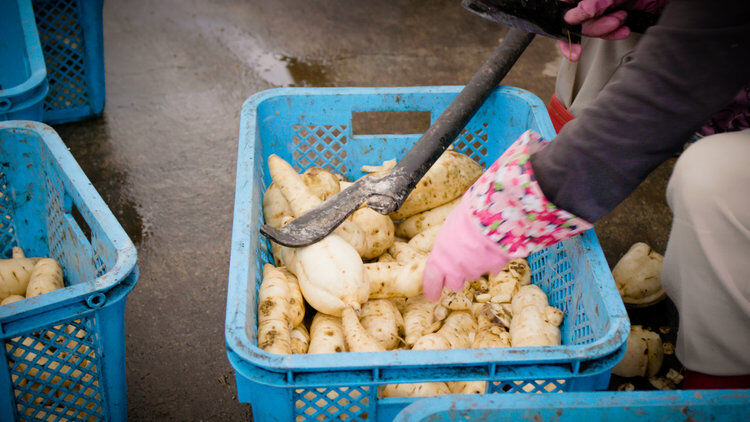
While one of us sets up the washing area, the other hand pulls another quarter ton of freshly harvested sweet potatoes from a second tote waiting nearby. Tekkan busies himself, getting decked out in Patagonia fly-fishing waders and a heavy waterproof jacket. He pulls on boots, latex gloves, and finally rubber gloves that reach above his elbows. He takes a deep breath and deadlifts the first basket of potatoes. He dumps it over into the waiting open topped washing machine that’s already spraying water and spinning its nylon brushed rotors. The black earth covered kogane sengan quickly turn darker as the soil wets and then a dull yellow as the mud washes away.
Tekkan inspects the 30 kilograms of potatoes for any signs of rot or damage. He takes a random potato out of the washer with one hand and deftly slices it in half with the teba knife in his other. The severed half disappears back into the roiling tumble of increasingly clean potatoes. He sniffs the half in his hand. Not smelling any signs of disease, he drops the remaining half back into the morass. When he finds one with signs of rot, he trims away bit by bit to see if any of the diseased potato can be salvaged. On a good day in a good harvest year, there are very few potatoes that have to be discarded entirely. On a bad day in a bad harvest year, up to a quarter of the yield may be discarded.

He steps back to check the progress. When satisfied, he pulls a lever and the right side of the washing machine bows toward the ground like an obedient dog. He yanks another lever and a trap door releases the startingly white potatoes into a waiting sky blue plastic basket. Reversing the levers closes the trap door and lifts the machine back to horizontal. In goes the next basket to be cleaned.
I use a metal hook to drag the clean basket to the trimming area where myself and two retirees from the morning shift will hand inspect and trim each potato. Before she retired, “genki-obachan” as I called her could process 2½ baskets in the time it took me to do one. She had worked as a cook in a hospital cafeteria for 20 years before retiring. Her hands were blindingly fast as she cut the ends off each potato. She would quickly inspect the rest of the surface for signs of minor rot and shave those away. All in the time it would take me to pull a potato from my basket and trim the first end. I’ve gotten better over the years, but I doubt I will ever reach her level of proficiency. I hope she’s enjoying her retirement.

Today my trimming colleagues are a married couple. The husband works sedately, but who can blame him? He’s 86 years old this year. His wife is a spry 79 so she is about as fast as me.
Speed isn’t the most important thing. Precision is. Each potato his hand inspects, ends trimmed, and signs of rot removed. The ends are bitter, which makes the shochu bitter. Any rot that ends up in the fermentation won’t necessarily ruin it since the potatoes are steamed long enough to kill any bacteria, but it can certainly affect the flavor and aroma. I take pride in my ability to spot rot and remove it. I am not so certain about the ability of my elders so I spot check their baskets as I move them to the pallets where they will be transported by forklift to the steamer. I do this heavy lifting so they don’t have to. I also do it, because it gives me a chance to stretch my legs and back, which get tight after squatting on a low stool in the chill autumn air.
About an hour later Ko-chan, who works both the morning shift and the afternoon shift, steps out from the distillery and calls to me. I strip off my rain suit and dirty gloves. I wash my hands and forearms with soap and water. I slip out of the boots and into my Vans for the short walk into the distillery. The shoes come right off again as I step into awaiting rubber shoes in the anteroom to the koji muro, or koji room. But before I get to the koji room, let’s talk about the rubber shoes. Imagine knockoff Crocks. Not attractive. They were about $4 at the local home center.
As I open the sliding wooden door to the koji muro, I am hit by a wave of summer heat. A shocking transition from the chill of the distillery floor. The distillery itself does not have climate control. Only the koji muro has any heating at all. Steam pipes line the floorboards and heat and humidity are adjusted through a series of gauges and wooden flaps that can be opened or closed to different degrees.
Ko-chan is busy setting up for breaking up the mound of koji inoculated rice that waits covered in ancient burlap rice sacks and old futon blankets on a low table in the center of the room. He’s my age, a little league baseball coach, and the only other full-time distillery worker besides Tekkan. He’s still seasonal, but he puts in a full day 5 days a week from September to January.
As he sets up a machine at one end of the table, I remove the sacks and blankets to reveal a large sailing canvas – the final layer. As we open it up, the rice mound is hard and warm to the touch. It’s completed about 40% of its journey from rice to koji. When this process is complete, it will no longer be considered rice, but kome koji or rice koji. We work to shovel the dry, caked rice away from the machine.
Ko-chan turns on the machine. It whirs to life. I take my shovel and take a dig into the mound, carefully lifting it up over the lip of the receptacle on top of the machine. I drop my load and the hiss of rice clumps being pulverized by steel bars spinning on a high speed rotor permeates the room. We take turns dumping shovels full of rice into the mouth of the machine. Our rhythm improves and before long we are not banging shovels or waiting for one another to finish a load. As the separated rice pours out of the bottom of the machine it quickly creates a new mound, which we periodically have to shovel away to keep it from clogging up the exit.
The original clumped mound is converted to a fresh mound of dry rice grains. When we finish the last of this process, Ko-chan turns off the machine. The silence is obvious after the constant thrum of the motor and roar of the rice pulverizing. Ko-chan dusts off the machine to extricate any rice grains that may be hiding in its innards. There’s always some, but we can’t let any get away. As he does that, I begin forming a new mound. I tuck an electric thermometer probe into the mound to check the temperature. Satisfied, we rewrap the mound in sailing canvas and old futon blankets. The burlap sacks are not replaced so that the temperature will rise more slowly from now until the next stage of koji making.
As I return to the sweet potato washing area, I run my fingers through my hair to rid it of any rice grains that may have hitchhiked out of the koji muro. As I redress in my still damp rain gear and boots, Tekkan gets a phone call. He waves me over. He needs to take it. I take his place washing the potatoes. It’s a monotonous but satisfying task. You can use the water jets to clean mud out of crevices in the surface of the potatoes. The crevices occur when the potatoes have not received enough rainfall during the season. But you have to be careful. Hit the angle of the water jet into the crevice at the wrong angle, and you’ll get mud in your eye. Literally. That’s not fun. Once I finish up the current wash, I throw the levers, empty the washer and drag the basket over to the waiting couple.
I step back to the washing machine, squat over a basket of potatoes and lift. The weight always surprises me the first time. The lurch to dump the basket into the washing machine is also a balancing act. Too strong and you risk throwing some potatoes over the back side. Too weak and you may dump the basket on the floor in front of you. I step back as the first wash begins and watch as the mud washes away. It happens gradually and then all at once. There’s nothing to do at this point, because you still can’t tell what is caked mud and what is rot. I turn my attention to the remaining baskets. I use the metal hook to drag them closer to the machine to make future transitions faster. The only way to save time with this part of the process without risking the quality of the fermentation is to make the transition from one load to the next as fast as possible.
When Tekkan returns he thanks me for taking over and I head back to the trimming area. As I lower myself onto the low stool where I had been working until an hour ago, I realize we’ve made some decent progress. Within a few minutes my fingers are reminded that they are wet and cold. The warmth of the koji muro is a fading memory. The old lady recognizes my discomfort, reaches into her bag and hands me a small warm can of convenience store coffee. I thank her, grateful for the little bit of warmth. I take a big swig, realizing immediately that it contains both milk and sugar. This is almost a guilty pleasure. I’ve been drinking my coffee black for well over a decade.
We process 32 baskets of potatoes in about 3 hours. Sometimes it’s faster, sometimes it’s much slower. It all depends on the quality of the harvest. I leave the clean-up to the older couple and follow the forklift around to the front of the distillery where sliding doors have been opened to allow access to the conveyor that lifts the potatoes into the steamer. The trimmed potatoes get one more rinse as they ride up the ancient conveyor through jet spray nozzles arranged inside the machine’s old steel body. It’s not so much a conveyor belt as a conveyor corkscrew. If too many potatoes are put into the machine at once you can jam it up and overpower the low horsepower motor. It’s patient work.
I offer to unload the last few baskets for Ko-chan. He waves me toward the potato steamer. I nod, and climb the steel ladder welded to the side of the steamer in my wet rubber boots. When I reach a step that is a platform rather than a steel bar, I know I’ve reached my destination. I am about 10 feet off the ground and in front of me is a large trapdoor in the top of the steamer now nearly full of freshly washed and trimmed sweet potatoes. The sound of spray of water from the conveyor is muted by the tumbling of the potatoes against the old steel walls of the conveyor’s cover. The potatoes enter from the corkscrew conveyor at the far opposite end of the steamer.
I twist my torso around to reach for an old, heavy rake tucked into the rafters of the distillery. I stretch the rake under the roof of the steamer and blindly drag the potatoes into other corners of the rapidly shrinking space. If I drag too aggressively I risk banging my hand between the wall of the steamer and the rake handle. If I drag at the wrong angle upward I risk banging my elbow on the safety railing that secures my perch. The work is constant and back-breaking to keep those falling potatoes from blocking the entrance to the steamer. I also set the goal of making the surface as flat as possible to assure an even steam.
I know the work is finally finished when the thrum of the potatoes banging on steel walls is replaced by only the spray of water. I hear the ending of the mid-day jingle playing over the town loudspeakers, letting everyone know it’s time for a lunch break. The morning shift is ending. As Ko-chan kills the water spray, the silence is sudden. I am left to finish my work, return the rake to its resting place, and close the heavy steel door on top of the steamer. Ko-chan thanks me for my effort. He usually has to do that raking by himself. I can tell he welcomes the relief.
I step out of the distillery into the noon day sun. The morning shift is finally over. As I strip off my rain gear and boots, the sun on my skin feels fantastic. I wash my hands and face in an outdoor sink before jogging back to the office. I find Tekkan at his desk, ordering his next potato shipment over the phone. He tells the broker that the potatoes today were excellent so he hopes he can get a similar delivery in two days time. He hangs up the phone and wipes his brow with a hand towel before turning to me with inquisitive eyes.
Lunch? I ask.
He shrugs and says, “Sorry. Isogashi.” He’s too busy for lunch today. I offer to get something for him from the convenience store. He smiles and gives me his order. He also pushes 2000 yen into my hand. He insists room and board means room and board even if he can’t be there to pay. I don’t resist. He forgets often enough that I don’t feel guilty.
MORNING SHIFT CREDITS
Theme Song: Begin Anywhere by Tomoko Miyata (http://tomokomiyata.net/)
Mixing and Editing and Voice Work: Rich Pav of the amazing Uncanny Robot Podcast. He also edits the excellent Uncanny Japan podcast.
Distillery Background Sound courtesy of the Japanese Sake & Shochu Makers Association.
Background Music for this Episode in Order of Appearance:
Chill Wave by Kevin MacLeod Link: https://filmmusic.io/song/3498-chill-wave License: https://filmmusic.io/standard-license
Vlog Lofi by Ramol Link: https://filmmusic.io/song/7071-vlog-lofi License: https://filmmusic.io/standard-license
Bass Vibes by Kevin MacLeod Link: https://filmmusic.io/song/3422-bass-vibes License: https://filmmusic.io/standard-license
Full Moon Lofi Vibes by EdiKey20 Link: https://filmmusic.io/song/7672-full-moon-lofi-vibes License: https://filmmusic.io/standard-license
Positive Fat Bass Intro Loop by WinnieTheMoog Link: https://filmmusic.io/song/6093-positive-fat-bass-intro-loop License: https://filmmusic.io/standard-license
Lofi Chill Hip-Hop by WinnieTheMoog Link: https://filmmusic.io/song/6347-lofi-chill-hip-hop License: https://filmmusic.io/standard-license