
• Skip to primary navigation
  • Skip to main content
  • Skip to primary sidebar
Japan Distilled logo in black.

Japan Distilled

Home of the Japan Distilled Podcast

  • Home
  • Podcast Episodes
  • About Us
  • Contact Us
  • Show Search
Hide Search

Podcast

The Most Powerful Toji Guild (Ep. 39)

July 6, 2022 · 1 Comment

EPISODE INTRO

In episode 39 of the Japan Distilled podcast, your hosts Christopher Pellegrini and Stephen Lyman introduce you to the most powerful toji guild in Japanese history, the Kurose Toji. This guild absolutely revolutionized and subsequently professionalized shochu production in the 20th century. And yet today, the guild has nearly disappeared with just a few remaining master brewer-distillers keeping their former powerhouse from going extinct.

CREDITS

Theme Song: Begin Anywhere by Tomoko Miyata (http://tomokomiyata.net/)

Mixing and Editing: Rich Pav (https://www.uncannyrobotpodcast.com/)

HOSTS

CHRISTOPHER PELLEGRINI Vermont born and bred, long-time Tokyo resident and author of The Shochu Handbook, Christopher learned about delicious fermentations as a beer brewer at Otter Creek (Middlebury, VT). He now spends most of his waking hours convincing strangers that shochu and awamori are unlike anything they’ve ever tried before. 

STEPHEN LYMAN discovered Japan’s indigenous spirits at an izakaya in New York City. He was so enthralled that he now lives in Japan and works in a tiny craft shochu distillery every autumn. His first book, The Complete Guide to Japanese Drinks, was nominated for a 2020 James Beard Award.

Stephen and Christopher were guests of the Kurose Toji Guild in preparation for this episode.

If you have any comments or questions about this episode, please reach out to Stephen or Christopher via Twitter. We would love to hear from you. 

SHOW NOTES

From Moonshine to Corporate Entity

During the Meiji Restoration many formerly informal Japanese businesses were forced to privatize as the newly formed government needed to expand its tax revenue in order to rapidly modernize to protect the country against the possibility of foreign colonization.

As such, during 1884-1885, shochu makers were overnight turned form farm distillers to businesses. This didn’t do much to change their lives since their products were still not effectively taxed. That change in 1898 when the first taxes on alcohol production were instituted. Seemingly overnight stills disappeared into hidden mountain retreats and those that remained had a sudden need for a consistent product that they could actually sell.

Given that distillation at this time was done on an extremely small scale, these were not necessarily viable businesses without the assistance of craftsmen who knew how to make a robust fermentation in Kyushu’s hot, humid environment.

Since necessity is the mother of invention, a market grew up and was filled by the toji guilds.

Kurose Toji Guild

Since all shochu was handmade at this time, the most vital aspect of the process was the development of a robust koji fermentation. This required carefully maintenance of temperature and humidity suited to the environment where the shochu was being made. In short, it required the knowledge, skills, and experience of a master craftsman, or toji.

Most distilleries were owned and operated by farmers or fishermen so they didn’t necessarily have the requisite skill to make a reliable, delicious product on their own. Yet the tax demands instituted in the late 1890s made this an imperative for continued economic viability.

What a toji guild team might have looked like.

In 1902, three men from Kasasa Village in Southern Kagoshima Prefecture collaborated to create the Korose Toji Guild: Hajime Katahira (b. 1884, d. 1936), Minosuke Kurose (b. 1882, d. 1967), and Tsunekichi Kurose (b. 1885, d. 1925). Note that all three were 20 years old or younger when the founded the guild, but they were onto something.

Katahira, who came from a sake brewing background, introduced the staged fermentation process, which allowed for a strong starter fermentation by cultivating more koji and yeast cells prior to introducing the main starch source. Nearly all shochu is made in this style today, but previously the “donburi” method was predominant in which water, yeast, koji, and the main starch source were all added to a single fermentation. This new technique provided for a more stable, more delicious fermentation, which also resulted in higher yields.

The two members of the Kurose family had been trained in the production of Okinawan awamori so they brought black koji to the guild’s arsenal. This allowed for a much more consistent and stable fermentation in the hot, humid Kyushu climate.

The three quickly began recruiting other men from the community to join their guild. Soon the guild had swelled to several hundred members, all living in Kasasa, and being sent out to distilleries across Kyushu and beyond for seasonal production. They’d return in the spring to work their village’s fields before being sent out to produce shochu again the next year.

guild notes.
kurose toji guild
old data keeping.

By the 1950s there were over 400 guild members and new classes of 50 students a year. And they were well paid. By this time a 15 year old toji guild member could draw an annual income nearly equivalent to the average salary in Japan. Compensation would only increase with experience until they were promoted to “toji” at which point they would be sent out as a team leader to one of the hundreds of distilleries that contracted their services.

Death of the Toji Guild(s)

As quickly as the Kurose Toji Guild and the nearby competing Ata Toji Guild rose to power, their grip on the shochu industry began to wane. This happened for two key reasons.

First, the introduction of the Kawachi Drum, which is an automatic koji making machine developed by the same Professor Kawachi who discovered white koji. Once a machine could make koji consistently, the need for a true master toji was greatly diminished.

A modern Kawachi Drum for koji making.

Second, as shochu became more popular throughout Japan in the 1970s, expansion lead companies to hire their own full-time head toji, which reduced the demand for the guild’s services.
toji guild
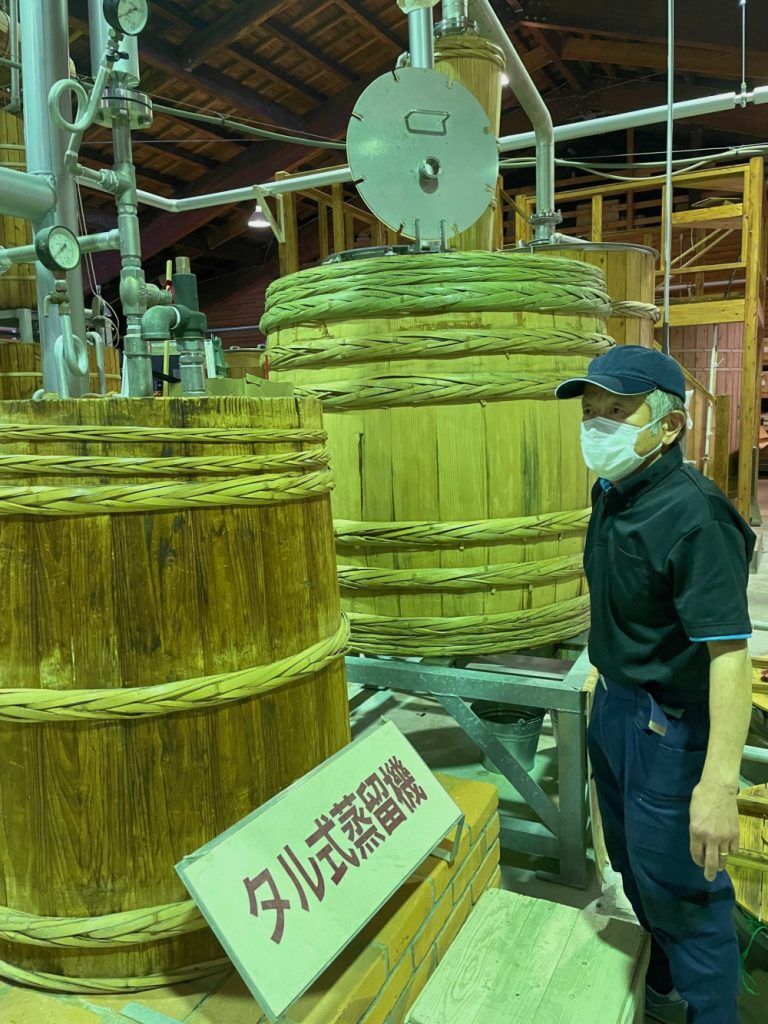
Current Kurose Toji at Toji no Sato Kasasa Distillery.

Today the Ata Toji Guild is extinct and there are only two active members of the Kurose Toji Guild. One runs the Toji no Sato Kasasa Distillery in Kasasa Village and the other is in training at a sake brewery in Saga Prefecture. He is expected to take over Toji no Sato in the future.

Much More to Explore

These show notes just scratch the surface, but should serve as a useful aid as you listen to the episode itself. As always, please feel free to reach out if you have any questions about the toji guilds.

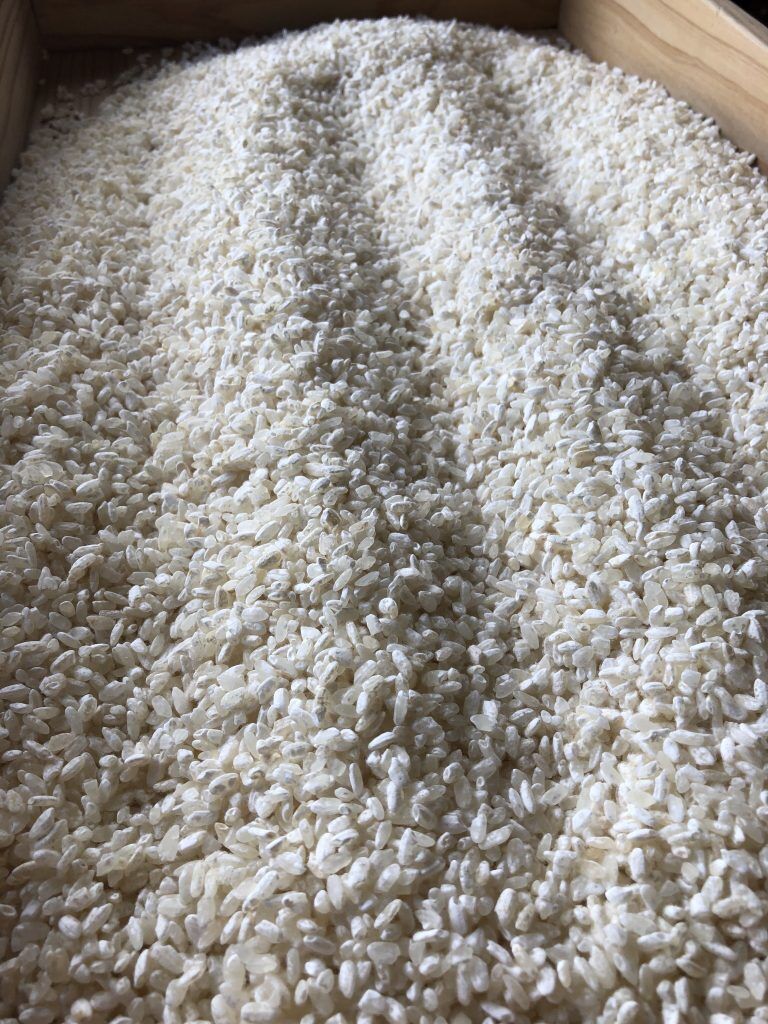
idon shochu from Toji no Sato Kasasa Distillery

Oh, and what were we sipping on? Rare that we both sip on the same thing. We were enjoying I-don from Toji no Sato Kasasa Distillery. Available only through lottery in Japan.
Kanpai!

Koji: the magical mold (Ep. 38)

June 29, 2022 · Leave a Comment

EPISODE INTRO

In episode 38 of the Japan Distilled podcast, your hosts Christopher Pellegrini and Stephen Lyman dive into national mold of Japan. Without koji (aspergillus oryzae, kawachi, or awamori) there would not be a Japanese culinary tradition as we understand it today. Nor would there be the Japanese spirits we all know and love.

CREDITS

Theme Song: Begin Anywhere by Tomoko Miyata (http://tomokomiyata.net/)

Mixing and Editing: Rich Pav (https://www.uncannyrobotpodcast.com/)

HOSTS

CHRISTOPHER PELLEGRINI Vermont born and bred, long-time Tokyo resident and author of The Shochu Handbook, Christopher learned about delicious fermentations as a beer brewer at Otter Creek (Middlebury, VT). He now spends most of his waking hours convincing strangers that shochu and awamori are unlike anything they’ve ever tried before. 

STEPHEN LYMAN discovered Japan’s indigenous spirits at an izakaya in New York City. He was so enthralled that he now lives in Japan and works in a tiny craft shochu distillery every autumn. His first book, The Complete Guide to Japanese Drinks, was nominated for a 2020 James Beard Award.

Stephen and Christopher have been fermentation geeks for a very long time.

If you have any comments or questions about this episode, please reach out to Stephen or Christopher via Twitter. We would love to hear from you. 

SHOW NOTES

What is koji?

Koji is the national mold of Japan. Without it there wouldn’t be soy sauce, miso, mirin, sake, shochu, or awamori as we know them. It’s a critical ingredient in Japanese fermentation traditions. Originally introduced to Japan as part of the Chinese yeast balls, or jiuqu, koji was isolated by Buddhist monks for sake production as early as the 700s CE and possibly earlier.

rice koji
Inoculated Rice.

Koji is a mold that grows in hot, humid environments, as do most molds, but this is a productive mold. During its fermentation process it releases generous amounts of two key enzymes: amylase and protease. Amylase saccharifies starches, such as rice or barley, and protease breaks down proteins to create amino acids (umami).

When used to make beverage alcohol, the amylase replaces malting as would be used in beer or whisky production. To learn more about the differences, please listen to episode 27 on Malt v. Koji.

Production

The mold is purchased from one of several mold factories throughout Japan. The spores are spread on freshly steamed barley or rice for most spirits production, though koji can be grown on virtually any starch source. Soba, corn, sweet potatoes, and soy beans have all been used as substrates various fermentations.

Once the spores are inoculated on the starch source, careful temperature and humidity must be controlled to give the koji an opportunity to infiltrate to feed and create the desired enzymes. In addition to protease and amylase, heat is generated so the fermentation must be cooled to maintain optimum temperature. The mold is most active from a range of about 30-42 degrees Celsius (86-108 Fahrenheit).

Koji Types

Three kinds of koji are used for alcohol production. Nearly all sake is made with yellow koji, which has been used in alcohol fermentations in Japan for over 1,300 years. The yellow variety requires assistance from the addition of acidity to protect the fermentation. This was traditionally done with lactic acid bacteria, but more recently commercial acid is added to modern sake fermentations.

Black koji is native to Okinawa and has been used to make Awamori for as many as 600 years since distilling technology first arrived on the islands. Today black koji is the only type permitted for making Ryukyu Awamori. This mold creates natural citric acid when the proper temperature range is maintained during inoculation. This helps protect the ferment in the hot, humid climate of Okinawa. Spirits made with black koji tend to have deep, earthy, umami-laden flavors and aromas.

Finally, white koji is recent to the party. This mutation of the black variety was discovered in a laboratory in Kumamoto in 1918. Today a majority of honkaku shochu is made using white koji, though yellow and black are still commonly used. This white variety also creates copious citric acid when the inoculation is properly temperature controlled. White koji tends to be more reserved, allowing the flavors and aromas of the base ingredients to shine through.

Much More to Explore

These show notes just scratch the surface, but should serve as a useful aid as you listen to the episode itself. As always, please feel free to reach out if you have any questions about koji.

KANPAI!

Sundays Spirits with Elliot Faber (Ep. 37)

June 16, 2022 · Leave a Comment

EPISODE INTRO

In the 37th episode of the Japan Distilled podcast, your host Stephen Lyman has a wide ranging conversation with Elliot Faber of Sundays Spirits in Hong Kong. His journey from Calgary to Scotland to Hong Kong is a winding road of adventure, opportunity, and hard work.

CREDITS

Theme Song: Begin Anywhere by Tomoko Miyata (http://tomokomiyata.net/)

Mixing and Editing: Rich Pav (https://www.uncannyjapan.com/)

HOST

STEPHEN LYMAN discovered Japan’s indigenous spirits at an izakaya in New York City. He was so enthralled that he now lives in Japan and works in a tiny craft shochu distillery every autumn. His first book, The Complete Guide to Japanese Drinks, was nominated for a 2020 James Beard Award.

Stephen has been communicating online with Elliot Faber for a long time. This was their first time actually speaking.

If you have any comments or questions about this episode or any other, please reach out to Stephen or Christopher via Twitter. We would love to hear from you. 

SHOW NOTES

What is Sundays Spirits?

Sundays Spirits was born out of the long time collaboration between Elliot Faber, chef Matt Abergel, and Lindsay Jang. Matt and Lindsay’s izakaya, Yardbird, opened in Hong Kong in 2011 and they immediately brought Elliot on as their beverage director.

Sundays Spirits
Yardbird, Hong Kong’s premier izakaya.

Elliot relocated from Canada to Hong Kong to join the team and since then they have all been relentlessly dedicated to expanding their restaurant group and eventually opening two different beverage alcohol companies. Sunday’s Distribution is a Hong Kong-based importer and distributor for world alcohols while Sundays Spirits is a brand portfolio of beverage alcohols created in collaboration with Japanese sake and spirits makers.

Sake Chops

Elliot Faber with his book, a true sake bible.

In just a few short years, Elliot has become a globally recognized expert on Japanese alcohol, but particularly sake. His book, Sake: The History, Stories, and Craft of Japan’s Artisinal Breweries is one of the most beautiful books on the subject we’ve ever seen. In 2016, he was recognized as a Sake Samurai by the Japan Sake Brewer’s Association. He’s also founded Sake Central, a global community for sake lovers.

Sundays Spirits
Gift pack from Sake Central.

Continuing the Journey

Today, Sundays Distribution allows Elliot to share his passion with Hong Kong while Sundays Spirits gives him an opportunity to share his favorite drinks with the world.

KANPAI!

The Evening Work at a Shochu Distillery (Ep. 36)

May 27, 2022 · Leave a Comment

EPISODE INTRO

In the 36th episode of the Japan Distilled podcast, your host Stephen Lyman takes you on an auditory journey, exploring the evening work in a handmade shochu distillery. This is a departure from our usual Japan Distilled podcast as we enlist the voice over assistance of our editor Rich Pav who also incorporated all of the music and sound effects. This is part 3 in this 3 part series encompassing a day in the life of a shochu distillery.

THE EVENING WORK HOST

STEPHEN LYMAN discovered Japan’s indigenous spirits at an izakaya in New York City. He was so enthralled that he now lives in Japan and works in a tiny craft shochu distillery every autumn. His first book, The Complete Guide to Japanese Drinks, was nominated for a 2020 James Beard Award.

Stephen has been writing professionally for over two decades, but this is his first attempt at writing a narrative audio story. He stared working at Yamatozakura Distillery in October 2013 and has done hours and hours of evening work at this point.

If you have any comments or questions about this evening work episode, please reach out to Stephen or Christopher via Twitter. We would love to hear from you. 

THE EVENING WORK SHOW NOTES

Evening Work Transcript

As the clock strikes 5, I can faintly hear the town loudspeakers once again come to life with the tune that signifies the end of the work day. The labeling ladies shout out a sing song “otsukaresamadeshita!” and make their escape. The bottles that need labeling will still be here tomorrow. 

I am left with the bottling line as Tekkan’s father continues to fiddle with the ancient labeling machine. Tekkan hurriedly packs up orders and applies shipping labels for that day’s deliveries. Delivery trucks will be arriving soon to ship Yamato Zakura to fine bars, restaurants, and liquor shops nationwide. 

I can tell the bottling tank is running low by checking a clear rubber tube that serves as a fill guide. Another of seemingly endless hacks Tekkan and his father have worked out through their years of experience and pure ingenuity. I finish up the last few bottles as I hear the first of the delivery truck back-up signals. It’s time to help load up the trucks. 

Today’s shipments are relatively light. Thursdays are busiest, as businesses prepare for their weekend rush. Next month will be extremely busy as everyone prepares for bonnenkai season, the notorious and absolutely fun forget-the-year parties. As the last of the trucks leave, Tekkan gives me a quick “otsukare” to let me know I can call it a day. There will be evening work later, but for now I can rest. 

I exit the bottling and aging warehouse, careful to close the sliding door completely behind me. These small movements help me maintain Tekkan’s expected level of perfection, and remind me in each step, that I can’t rely on my usual level of precision. If I am going to be completely honest, I am a big picture guy. I don’t sweat the small stuff. That’s always been someone else’s job. But at Yamatozakura, that’s my job. It’s been a revelation for me. Realizing how important every single decision I make can have on the final product, despite the fact that I am a tiny cog in a very small machine. 

In the parking lot, I find Tekkan’s boys kicking a soccer ball back and forth. Some days they bring their bicycles or baseball gloves, but today it’s soccer. Maybe, because they know I played for most of my life. I kick with them for a few minutes, before Tekkan comes out and lets them know their mother wants them home. Now. They complain, as kids do around the world. Another nudge from Tekkan, and they’re off for home. He shakes his head as he smiles at me. Fatherhood.

As I walk back to my 2nd floor apartment above the office, I realize how tired my feet are. I’ve barely sat down since breakfast. Sure, I sat on a stone wall for a quick lunch, and again for a quick afternoon break, but I haven’t had a proper sit since breakfast. Thinking back to my very first time working at Yamatozakura, I remember my realization that there are no chairs in the distillery. There is no place to sit down. 

That’s not entirely true. There are chairs around a table in the oba-chan’s break room, but that’s always felt off limits to me. They go in there and gossip over tea, and I have not once intruded on their relaxation. I am sure working with me is stressful enough. Having to socialize as well? I save that for once a season. I treat them to lunch on my last day. They don’t mind a free meal. Who would?

Slipping out of my shoes and stepping into the apartment, I open the fridge and pull out a cold beer. Is there anything more refreshing than an ice cold lager after a very long workday? It used to be Asahi Super Dry, but my brother from another mother, Christopher Pellegrini, eventually convinced me to drink better beer. Now it’s Orion from Okinawa when I can find it, or Sapporo Black Label. I strip off a few layers until I am down to a t-shirt and shorts. I climb the stairs to the 2nd floor where, I have a sofa and coffee table. 

I know I claimed not to have a TV, but actually I do. I tune into the sumo tournament, which happens to be happening while I am working at Yamatozakura this year. Sadly, it’s happening in Fukuoka, where I live. I’ve only attended in person once and it was amazing. It’s hard to imagine a more ritualized and traditional sport, that still manages to show incredible athleticism and strategy. I can’t pretend to ever remember the names of wrestlers from tournament to tournament, but it’s a great distraction after a long day. 

Sumo on TV is almost as fun as Sumo in person.

Sumo is weird though. Unlike American or European sports, the tournament is over for the day by early evening. No primetime viewing available. As the tournament winds down, I finish my beer and check the time. I head to the bedroom, and pull in a fresh set of clothes for the evening work. 

Before walking back to Tekkan’s house, I put a load of laundry into the machine. I dirty 2-3 sets of work clothes per day, so I need to do laundry every other day to keep in supply. Each season Tekkan has to re-teach me how to use the washing machine, because it’s entirely in Japanese, and despite my increased language proficiency, some of those button names just don’t make sense. 

I drop my beer can in the recycling bin and slip back into my Vans. The walk to Tekkan’s house is crisp, but pleasant. A couple of children play in the park, despite it now being after dusk. Their mothers idly chitchat on a bench in the dark.

Slipping off my shoes in the foyer of Tekkan’s house before dinner, is one of the most pleasant moments of my day. I know delicious food awaits, and unlike the morning, when his boys are either tired or busy with last minute homework, now they are watching anime on TV. Their eyes shine with happiness as they see me come inside. Forever polite, they thank me for playing soccer for a few minutes before turning back to the TV. 

The next thing that hits me are the aromas. Tekkan’s wife and mother-in-law have harvested fresh salad fixings from the garden in the yard. Quick pickles and homemade potato salad are already plated and served. I spy the electric dumpling hotplate on the dining table. Gyoza night. This is a bloodsport. The boys can eat their weight in dumplings and I am famished. 

Tekkan sits at the dining table engrossed in his iphone. He doesn’t doom scroll. He’s constantly looking for 2 things: love for Yamatozakura and clues about what trends might be coming soon. He’s a genius at identifying what will be popular next. 

Several years before anyone else recommended shochu with sparkling water, Tekkan sat me down on a night much like tonight, and served me his purple sweet potato shochu with soda. It tasted like grape soda. Since then, I have become a big fan of shochu-soda. Today the industry is transforming as makers rush to find new recipes that shine with bubbles. It’s transformed how shochu is consumed in Japan and overseas. I can’t say that Tekkan started it, but he saw it coming. 

When he realizes I’ve arrived, he smiles. Next to him are two small unlabeled glass bottles. This year’s shinshu. He pours each into small Kagoshima style oyuwari glasses and pushes them toward me. I nose them each in turn. Both have the gassy aromas I associate with shinshu, but one is decidedly more reserved. I already know which I will prefer. Shinshu is newly made shochu. It’s a relatively recent style and I can’t say I am a fan. 

Due to the single pot distillation and the fact that nearly all of the heads are kept, they are funky and wild and not particularly good for your health. If I ever indulge in more than a couple glasses, I end up with a terrific headache the next day. I don’t think that’s the alcohol. I think that’s the off gasses. These volatile organic compounds degrade during aging, but right off the still they are a kick in the head. 

But Tekkan makes such clean fermentations, his shinshu is easily one of my favorite every year. This year he’s asked for my opinion. I’m chuffed. I try each. My nose didn’t lie. I like the softer one better. 

Dinner time. Our tasting interrupted, we all gather around the dinner table and sing-song “itadakimasu!” – the boys dive into the gyoza with abandon. They’re still bubbling as they shove them into their mouths, which, of course, results in the expected “too hot” reaction universal to impatient eaters world wide. I take a more strategic approach, buliding my ponzu and hot chile oil dipping sauce before digging into the salads and pickles. 

As the boys nurse their tongues, I attack my corner of the gyoza field with abandon. Before long they realize they’re losing ground and dive back in. From there it’s simply who can chew and swallow the fastest. Somewhat satisfied, I slow my pace and plate more salad. 

I return to the shinshu shochu samples. I make a hot water service for each. They are both delicious. I actually have a slight preference for the more robust version. Tekkan’s watching out of the corner of his eye as the gyoza disappear. Fortunately, reinforcements are on their way. An entire new sheet of gyoza appear for the 2nd half. 

As we wait for them to cook, I go back to the shinshu and try them on the rocks and then with a splash of soda. My original recommendation holds. I let Tekkan know. He nods approvingly. He had previously done the same blind tasting with 2 liquor shop owners he respects. They made the same recommendation. This year’s shinshu is decided. 

The boys run out of gas during the second round of gyoza. I am left to clean up the spoils. Those amateurs and their small stomachs didn’t stand a chance. They retreat to the couch to watch another 30 minutes of anime before grandma forces them into the tub for their evening bathtime. 

Tekkan and I chat idly until we’ve finished our dinner. Knowing this time is precious for Tekkan and his wife, I make my escape. The sky is now pitch black and the air is decidedly colder. 

Returning to my apartment, I take the laundry out of the washer and hang it to dry. Returning to the sofa, I lie down and close my eyes. 

I startle awake to the vibration of my phone on the coffee table. It’s Tekkan. As I answer he simply says, “koji muro ni” … 

I check the time. I’ve been asleep for about an hour but it feels like days. The exhaustion is real. 

When I arrive in the koji room, Tekkan is already hard at his evening work. He’s hand mixing the rice in each wooden box to cool and aerate the koji. I join him. We each take a side of the room. My side has about 10 fewer boxes, so we usually finish at about the same time. He also gives me the side facing the exterior wall of the distillery. This side of the koji room is cooler than the other side so if I screw up, the koji isn’t as likely to reach a critical temperature before he has a chance to check it in the middle of the night. 

We usually chat for the first few minutes, covering any topics he has on his mind that we didn’t discuss earlier in the day. But then we lapse into the routine. The sounds are mesmerizing and the entire cooling process is dictated by the feel of the rice koji in your hands.

evening work
Mixing the rice by hand cools it down and aerates the koji mold.

The goal is to cool it to a temperature just about equal to the human body temperature. But this is confounded by the fact that it’s hot and humid in the koji room, even on this chilly evening so you begin sweating almost immediately. 

Once I start sweating, the rice grains begin sticking to my hands and wrists as I do the work. I have to be careful to sweep away any that cling to me. Remember, there’s a god in every grain of rice and I am sure none of them want to be carried out of the koji room on the hairy arms of a foreigner. 

Tekkan’s side of the room falls silent. With my back to him, I am unsure if he’s checking his phone or if he’s fallen asleep. By this time in the season, he can sleep standing up. I’ve never seen anything like it. I take a peek. Sure enough. He’s having a cat nap. I continue my evening work and let him rest. I’m more likely to finish about the same time he does if I don’t rouse him. 

Tekkan focuses on his evening work (the rice is actually mid-air during a toss).

During this evening work my mind wanders. I might be at my most creative. It’s a zen like experience. Some people go to yoga camp. I go to Yamato Zakura. It’s for moments like this when my mind can be completely empty and I can focus on nurturing the koji to its full potential. Without my assistance, it would die in obscurity. But I am simply a facilitator for the magic that this mold does. 

Invariably I spill a couple rice grains out of the wooden box onto the table. They can’t be returned, but I don’t want to waste them. I taste them instead. Sweet and sour. Tomorrow’s primary fermentation may be a healthy one. 

Tekkan starts awake. I can tell, because he suddenly starts working again. We labor on in silence until we’ve hand mixed all of the boxes too cool and aerate the koji. We finish the evening work at almost the exact same moment. As Tekkan puts thermometers into random boxes, I sweep the floor. Some rice has been spilled. 

As I empty my dust bin into the waste basket, I say a small silent prayer for who didn’t make it.

EVENING WORK CREDITS

Theme Song: Begin Anywhere by Tomoko Miyata (http://tomokomiyata.net/)

Mixing and Editing and Voice Work: Rich Pav of the amazing Uncanny Robot Podcast. He also edits the excellent Uncanny Japan podcast.

Distillery Background Sound courtesy of the Japanese Sake & Shochu Makers Association.

Background Music for this Episode in Order of Appearance:

Full Moon Lofi Vibes by EdiKey20
Link: https://filmmusic.io/song/7672-full-moon-lofi-vibes
License: https://filmmusic.io/standard-license

Bass Vibes by Kevin MacLeod Link: https://filmmusic.io/song/3422-bass-vibes License: https://filmmusic.io/standard-license

Vlog Lofi by Ramol Link: https://filmmusic.io/song/7071-vlog-lofi License: https://filmmusic.io/standard-license
Link: https://filmmusic.io/song/8246-don-t-hate-me
License: https://filmmusic.io/standard-license

Kanpai!

The Afternoon Shift in a Shochu Distillery (Ep. 35)

May 12, 2022 · Leave a Comment

EPISODE INTRO

In the 35th episode of the Japan Distilled podcast, your host Stephen Lyman takes you on an auditory journey, working the afternoon shift in a handmade shochu distillery. This is a pretty sharp departure from our usual Japan Distilled podcast as we enlist the voice over assistance of our editor Rich Pav who also incorporated all of the music and sound effects. This is part 2 in a planned 3 part series encompassing a day in the life of a shochu distillery.

THE AFTERNOON SHIFT HOST

STEPHEN LYMAN discovered Japan’s indigenous spirits at an izakaya in New York City. He was so enthralled that he now lives in Japan and works in a tiny craft shochu distillery every autumn. His first book, The Complete Guide to Japanese Drinks, was nominated for a 2020 James Beard Award.

Stephen has been writing professionally for over two decades, but this is his first attempt at writing a narrative audio story. He stared working at Yamatozakura Distillery in October 2013 and has worked dozens of afternoon shifts at this point.

If you have any comments or questions about this afternoon shift episode, please reach out to Stephen or Christopher via Twitter. We would love to hear from you. 

THE AFTERNOON SHIFT SHOW NOTES

The Afternoon Shift Transcript

I step out of the distillery into the noon day sun. As I strip off my rain gear and boots, the sun on my skin feels fantastic. I wash my hands and face in an outdoor sink before jogging back to the office. I find Tekkan at his desk, ordering his next sweet potato shipment over the phone. He tells the broker that the potatoes today were excellent so he hopes he can get a similar delivery in two days time. He hangs up the phone and wipes his brow with a hand towel before turning to me with inquisitive eyes. 

Lunch? 

He shrugs and says, “sorry. Isogashi.” He’s too busy for lunch today. I offer to get something for him from the convenience store. He smiles and gives me his order. He also pushes 2000 yen into my hand. He insists room and board means room and board even if he can’t be there to pay. I don’t resist. He forgets often enough that I don’t feel guilty. 

Tekkan asks me to prepare for de koji before I leave. This is the process of preparing the rice koji for today’s primary fermentation. I head back to the distillery, where I find Ko-chan firing up the sweet potato steamer. I slip out of my Vans into my fake Crocks, and shed my hoodie before stepping into the koji room’s sauna. I roll four long tables out of the koji muro into the anteroom. Atop the tables are dozens of wooden boxes. These hold the koji we made two days ago. It’s now been in the koji room for about 44 hours. In the anteroom, it will cool to room temperature before being used to start today’s primary fermentation. 

Finished, I head out for lunch. The 10 minute walk to the convenience store with the sun on my back is refreshing after the chilly, wet morning spent processing three-quarter tons of sweet potatoes. 

At the 7-11 the shop staff smile and bow with their singsong irasshaimase! I explore the prepared lunch offerings. Until Tekkan’s wife started her yoga studio, I was spoiled with daily homemade lunches. The first year he suggested we go to the conbini for lunch, I was disappointed, but I have grown to enjoy these simple, surprisingly well-prepared meals. I find Tekkan’s favorite spice curry bowl. For myself, I choose a steamed chicken pasta salad, and a bottle of cold green tea. I always use these visits to drop weight.

As I check out, the staff smiles and asks how long I’ll stay. About 9 days, I reply. She thanks me for my patronage and gives me a parting “Ganbatte kudasai!” I promise to work hard. 

I return with Tekkan’s lunch. He thanks me and digs in. He barely pauses his continuous paperwork and intermittent phone calls from liquor shops, restaurants, or friends just wanting to chat. It’s turned into a nice day, so I opt to enjoy my lunch outside, perching on a low stone wall that rims the distillery property. The unmistakable smell of steaming sweet potatoes wafts on the breeze. The mornings in the distillery are very much about physical intensity and tactile experiences. The afternoons are full of technical activities and wonderful aromas. 

Tekkan hurries past with a wave, as he goes into the distillery to check the steaming potatoes. Through the glass doors, I see him loading the rice steamer with the rice we had washed this morning. He must have drained the water before washing the potatoes. One of the myriad things he has to remember every day. I quickly finish my lunch to go help. 

The rice washing and steaming area is tucked between the koji muro and the conveyor belt that winds its way up to the top of the sweet potato steamer. Tekkan hands me the bucket to continue. I put about half of the rice into the steamer. Using a worn, flat piece of wood, I smooth out the top of the rice in the steamer to make it completely flat to assure even steaming. I crank up the steam and let it run until I can see the last of the rice in the steamer move from dry to wet, noticeable by how the rice changes from white to slightly less white. It changes from the perimeter inward toward the center. When I’m convinced it’s finished, I cut the steam. 

I take the shovel from the wall and dig it down into the partly steamed rice. It’s heavy and hot as I struggle to lift the load. I turn it over so that the rice that was on top is now on the bottom. I repeat this process for the entire half batch before again smoothing it out with the piece of worn wood. 

I use the bucket to put the remaining rice into the steamer and repeat the process. With that complete, I go find Tekkan. He’s just finished sanitizing one of the 400 liter ceramic pots that is buried in the cement floor. These pots are used for both fermentation and some long-term storage at Yamato Zakura. With this pot, he will build a primary fermentation. I let him know the first step of the rice steaming is finished. He nods.

I return to the rice steaming area to finish cleaning the rice washing tub. I work to capture every single grain. I put all the leftover rice into a sieve and rinse it with spring water before adding it to the rice already in the steamer. It is this process more than any that reminds me that every grain of rice contains a god, as Tekkan likes to tell me. We try to preserve every single grain. Not because it increases the final yield, but because we need to be aware of every small decision we make. If you start slacking off on little things, soon you’re ignoring big things. And that’s when the quality will suffer. So rather than start down that slippery slope, we take a few extra minutes to rescue every grain we can. 

That being said, unlike some other distilleries, rice that touches the floor is discarded. That’s for two reasons. First, because the fermentations at Yamato Zakura are so small, any unwanted organism could spoil an entire batch. And second, due to the distillery layout, we wear the same shoes indoors and out. Except for in the koji muro and anteroom. There we wear our ugly fake Crocks, or, koji shoes. But even in there, any rice that ends up on the floor is discarded. At that point rice is too close to the beginning of the primary fermentation to risk it.

Tekkan starts up the rice steamer, affixing the lid to direct the steam to an exhaust outlet in the ceiling. This helps keep the interior of the distillery from becoming too humid. As Tekkan gets the rice steamer going, I slip into my koji shoes and begin the process of de koji. I use a small hand brush and a wooden board placed across the mouth of a 20 gallon bucket. I take each wooden box and bang it on the wood board to loosen the rice koji. The koji, as it dries in the box, sticks to the wooden surface. The sudden jolt separates most of the koji from the wood. The small hand brush helps me get the rest of the koji out of the box. I repeat this process for all 150 kilograms of rice koji. 

Each time a 20 gallon bucket is full, I slip out of my koji shoes into my Vans and use a hand cart to move the bucket to the waiting ceramic pot. I carefully tip the bucket to allow the koji rice to slide slowly into the water and yeast waiting in the pot. I use a kaibo –  a bamboo shaft with a flat, wooden mallet-shaped head – to mix the koji rice into this primary fermentation.

Returning to the anteroom, I pause to inspect the rice koji. There is a beautiful white fluffy bloom of mold on the surface of the rice grains. If we were to examine  it under a microscope, it would look like a field of tiny white flowers. I taste a few grains. Thanks to the koji doing its job, the grains almost melt on my tongue with a sweet, acidic taste that I associate with koji. At times when enjoying sake, I find that the predominant flavor is that of rice koji. Once I taste it, it’s hard for me to identify any other flavor in the drink. 

As I continue the de koji, I am joined by “tsuyoi obachan, or strong grandma.” She works the afternoon shift. You’d never guess it by looking at her, but she’s the younger sister of “genki obachan”, the now-retired world champion sweet potato trimmer. Tsuyoi means strong in Japanese and if you saw this woman, you’d understand what I mean. She’s in her early seventies, but built like a brick shit house. She does the same work any man could do in the distillery, and smiles while doing it. She’s always good for a joke in her thick Satsuma dialect. So as usual, I have no idea what today’s gag might mean. We make quick work of the de koji. I leave her to clean up any spilled rice koji. Even though we try to capture every grain, there is inevitable spillage with the violent jarring of the wooden boxes against the wood board. 

I finish building the primary fermentation. It becomes harder and harder to mix with the kaibo as more and more rice koji is added to the pot. By the end it’s almost impossible to bury the kaibo to the bottom of the pot due to the weight of the rice koji. After I finish, I put a thermometer into the pot so Tekkan can check the temperature when he has a moment. 

I mix the other primary fermentations that are bubbling away in nearby pots. These will spend nearly a week fermenting, before we start the next step in the process. We stir these pots every few hours to give the aerobic koji a chance to breathe, so it can continue doing its job. As I move through the pots, one made each day, they become easier to stir. as more and more of the rice has been liquified by the koji and yeast. 

Tekkan finds me and asks me to wash bottles. He looks almost guilty. It’s everyone’s least favorite job in the distillery, especially once the weather turns cold. The bottle washing machine is outdoors under an open air lean-to. A pallet of cardboard boxes of 1.8 liter bottles waits just outside the shanty. I put on my rain suit, still damp from washing sweet potatoes this morning. Before starting the machine, I move boxes from the pallet to the staging area, to make sure I can be as efficient as possible. The sooner I finish, the sooner I can do something more interesting. Once ready, I crank open the water faucet, which feeds spray jets inside the ancient bottle washing machine. I press a series of buttons on the control panel and the machine lurches to life. 

The bottle washing machine is like a merry-go-round. It never stops moving unless you turn it off. The rotor creeps around very slowly so that 10 full cases, or 60 bottles, can be steam-sterilized at once. I let each set of bottles do two full rotations so I use a clothespin to mark where the batch starts and ends. Once they’ve finished two laps, I have a few seconds to remove each set of 6 clean bottles, and replace them with 6 unwashed bottles, in order to maximize efficiency. This will also minimize the amount of time I have to stand here in the cold, with mist spraying out of the mouth of the machine, gradually dampening everything I am wearing.

The bottles don’t go back into the cardboard. They are placed at a downward angle on a large metal rack with wheels, that will be rolled into the bottling room, where they will wait their turn to be filled. The cardboard boxes pile up around me, so whenever I am waiting for the 2nd lap to finish, I break down boxes and move fresh boxes into the staging area. 

Thankfully, Tekkan soon needs me for another task. I turn off the machine and cut the water. The sudden silence, broken only by the periodic hiss of the boiler in an adjacent outbuilding, is a relief after the clunking and clanging of the ancient machine, and the constant echo of spray jets inside the steel chamber. I quickly strip off my rain suit, and head back to the koji muro. 

Inside, Tekkan has uncovered the mound of rice koji that Ko-chan and I had broken up this morning. He’s using a shovel to mix the rice koji, which has again become warm to the touch. Too warm and the koji will stop its process. Too cool and, you guessed it, the koji will stop its process. So the mixing we had done this morning, and the process we will do now, are both designed to provide oxygen to the koji, and to maintain optimum temperature. 

Tekkan prepares the rice koji to separate into boxes.

Tekkan bends over the low table with a small wooden bucket in hand. I move a stack of 8 wooden koji boxes to the edge of the table. He takes a scoop of the waiting mound and pours it deftly into the top box. With his other hand, he pushes a divot into the top of the rice koji in the box, creating a mini volcano. This is perhaps appropriate since Kagoshima is also the home to Sakurajima, the most active volcano on earth.

I quickly move the box to the long table behind me. As I turn back to the center of the room, Tekkan is making another divot in the next box. I move that one aside to place on top of the first box. I stack these 8 high before using another box as a cover to maintain heat. I lift the next stack of 8 empty boxes to the edge of the table to begin the process again. This is the first time Tekkan and I have had time for a conversation since breakfast. 

We usually chat about which movies we’ve seen recently. He’s a huge fan of Star Wars and the Marvel Universe. I usually try to watch the latest releases within the few weeks before my annual visit so I’ll know what the hell he’s talking about. But he’ll also discover other movies or TV shows he’s now obsessed with. If he hasn’t had lunch, the topic is usually food. New restaurants he visited during the previous summer’s sales season. Or new places he wants to try. At other times he’s quizzing me about foreign tastes for shochu. 

We make quick work of the mound. Our system works well, but more than a few times a year, he has to do this by himself. 

I head back to the bottle washing machine to continue to tackle the monster. I don’t mind. The rhythm is reassuring. The constant sound of water, relaxing. I don’t exactly understand why, but the sound of running water is so soothing. I love washing dishes by hand for this same reason. My dream is to live near the ocean where I can open my bedroom window at night and fall asleep to the sound of the waves crashing on the beach. 

The challenge of bottle washing is the grip. The 1.8L bottles are wet and awkward. Since they go into the machine upside down, the fastest way to pick them up is by their very wide base. These bottles lack a punt, the dimple sometimes found in the bottom of wine bottles, so there’s no easy way to grab them with one hand. My hands are just big enough to lift out by the base with one hand, two at a time, but moving these bottles safely away from the mouth of the machine to place in the drying rack, is a constant challenge–one I have gotten better at. I am proud to say I’ve only broken one bottle in nearly a decade of work. 

Fortunately, today I don’t break any as I make it through a rack and a half before “hayai obachan, or fast grandma” appears over my shoulder to let me know Tekkan needs my help. As I strip off my rain gear once again, I watch her jog quickly back toward the main building. She runs everywhere. This slight woman in her 60s seems to have forgotten how to walk. Hayai means fast in Japanese. Thus her nickname. 

Turning off the water and the machine, again returns the area to relative silence. 

I find Tekkan removing the lid from the rice steamer. Tsuyoi obachan and hayai obachan wait in the anteroom–where they’ve moved the long, low table that had previously held the mound of rice koji in the koji muro.

They’ve also set up industrial fans blowing on the empty table. The steamer is on a hinged rack, so it can be tilted on end to empty the freshly steamed rice directly onto the table. It’s hot and somewhat dangerous work, as the steamed rice is hot enough to cause severe burns, if you were to come into direct contact. We all work with heavy leather gloves. 

Once everything is ready, with a 1-2-3, Tekkan releases the hinge lock. The steamer begins its slow descent to the table. Tsuyoi obachan and I guide it from the front, while Tekkan wrangles it from behind. When it’s close to the table, we again countdown to let it drop the last few centimeters on its own, with a loud thud. 

afternoon shift
Tekkan and another worker remove the steamed rice from the steamer.

Tsuyoi obachan and I use shovels to empty the rice out of the steamer. We spread it out on the table so it cools quickly. The steamed rice smells delicious. As we shovel deeper into the rice, it becomes harder to remove the rice by shovel. At this point we unclasp the canvas netting that lines the steamer. We countdown. Ichi! Ni! San! Seeeee-no! We simultaneously pull the heavy netting forward toward the center of the table. It only comes out part-way. We give it another heave-ho successfully. We again count to synchronize our lift to empty this canvas netting. 

I toss the empty netting into the steamer, as Tekkan moves it out of the way. As we shovel the rice flat to help it cool further, Tekkan closes the sliding doors of the anteroom so we can control temperature in the chill November air. 

We dig into the rice at one end of the table, and move it by shovel to the other end. Once we have created an empty 1 foot gap at one end of the table, we turn the adjacent rice over so that what was on the bottom, is now on top. We repeat this process all along the table. When finished, we do it again, to continue the cooling process. Tsuyoi obachan removes a glove, and digs her hand into the center of the rice, feeling the temperature. When she pulls her hand out, it’s turned bright red. She holds up one red finger to signal that we need to turn the rice one more time.

Genki Obachan (left) and Hayai Obachan (right) cool the rice.

Once finished, Tekkan enters with the koji mold, which he stores in the office. These white koji spores are purchased from one of just a handful of koji makers in Japan. He dons eye goggles and an N95 mask. Until a few years ago, he did this without protection, but after we made black koji shochu in 2016, he began using a flour sifter to get a finer distribution of koji spores on his steamed rice. This seems to have resulted in a bit of a koji sensitivity. It’s not nearly as bad as the few toji I have met who have an outright koji allergy. They have to rely on others to propagate the spores for them.

I watch him through the glass window as he slowly sifts koji over the rice. He repeats the process twice over the entire table. The fine cloud of spores settle on the rice but some escape, floating up into the rafters. When finished, he empties the contents of the shifter onto the table. These are rice koji grains that have gone to spore. These will be mixed into the koji. Again, no rice is wasted. 

Tekkan inoculates steamed rice with koji.

Now begins my least favorite part of the day. Not because it’s difficult, but because it requires an hour or more bending over this low table. Having been an athlete my entire life, my knees and back have become unhappy with certain movements and positions. Tekkan and I shovel the bed of rice into a mound at one end of the table. He checks the temperature by hand. It’s ready.

We kneel at the empty end of the table. I kneel on two cushions that were procured by hayai obachan once she realized how much pain kneeling on the floor caused me. Leaning over the low table, kneeling on the cushions still does my back no favors. However, we need to mix the koji that has been sprinkled on the steamed rice before the rice gets too cold. If not, the koji can’t take hold. 

The rice is hot to the touch. The goal is to mix the rice with our hands until it’s cooled to a little bit above human body temperature. It turns out I was quite good at determining the appropriate temperature right out of the gate so Tekkan always wants me to do this work when I am around. The ladies know their workday is almost finished when this work is done, so they sometimes rush through it, leaving the temperature too high or too low. I work very hard to get it just right. Tekkan and I work together in sweaty silence, until hayai obachan brings him the distillery’s wireless phone. He’s got other work to do, so she takes over. Tsuyoi obachan soon joins us, and the three of us chat away. Hayai obachan chats with me in standard Japanese, and then translates my responses into the local Satsuma dialect for tsuyoi obachan. The conversation invariably drifts toward food. By the end of this work, I always know what everyone’s had for lunch, what they are planning for dinner, and what to watch on TV that evening. As if I have time, or a TV.

After an hour of kneeling and straining and mixing my back is aching, my knees are barking, and my hands are raw. The fabric underneath the rice is not soft or forgiving. But its properties are good for the koji so we humans suffer. We check the temperature, find it to be just a touch too warm, so we dig our raw fingers into the mound and move it to the center of the table. We roll the table into the koji muro. We cover it with the sailing tarp, futon blankets, and ancient rice sacks. It will rest until morning, when Ko-chan and I wake it up. 

The ladies will clean up. I’ve earned a break. They had their afternoon tea while I was washing bottles. I step out into the chill late afternoon shade at the side of the building and stretch my back. I drink deeply from the cold spring water tap at an outdoor sink. It’s almost sweet. Absolutely the best tasting water I know. I drink more than I should, but I feel parched. I find a patch of sun on the stone wall and enjoy a few minutes of rest. 

Tekkan pokes his head out of the bottling warehouse entrance and waves to me. Back to work. Inside I find two other older women who I haven’t given nicknames hand-labeling newly filled bottles. Tekkan’s father putters around with the ancient bottling line, which only applies labels for the 1.8L bottles. And even then, only for a couple of their brands. It’s nearly outlived its usefulness, but he’s bound and determined to keep it running. 

Tekkan is busy preparing the dilution tank for the next day’s bottling. I join him, since I will inevitably learn something. He’s again smiling and chatty. He likes this part of the day, because the heaviest lifting is over. He wants me to try two different possible shin-shu blends he’s considering releasing this season. He promises we will taste them after dinner. 

There really isn’t any work for me to do with this dilution process other than hold the hose as the shochu starts to flow. As with so much around this small family distillery, everything is jerry rigged. The hose is tied with a string to a peg on the wall. When the flow starts, the hose can jump and if it jumps out of the tank, shochu that’s been aging for 2 years or more would be lost at the very last moment. I hold the hose. It doesn’t jump as the flow starts. Did I mention the 3M filter hung over the end of the hose? That’s DIY as well. That small task finished, Tekkan asks me to bottle what’s left in the bottling tank.

I set up the 6 bottle bottling machine, turn on the back light to catch any impurities that might have made it through the second filtration, and get to work. The rack of 1.8 liter bottles I had washed earlier in the day waits nearby. I roll it into position. This is another job that can be done most optimally if everything is just right. However, I can work faster than the old bottling machine. I only use 4 of the 6 slots to assure consistent flow. As each bottle reaches its fill line, I pull it out, press fit a cap, and place it in a nearby plastic crate. 

As the clock strikes 5, I can faintly hear the town loudspeakers once again come to life with the tune that signifies the end of the work day. The labeling ladies shout out a sing song “otsukaresamadeshita!” and make their escape. The bottles that need labeling will still be here tomorrow. 

I am left with the bottling line as Tekkan’s father continues to fiddle with the labeling machine. Tekkan hurriedly packs up orders and applies shipping labels for that day’s deliveries. Delivery trucks will be arriving soon to ship Yamato Zakura to fine bars, restaurants, and liquor shops nationwide. 

I can tell the bottling tank is running low by checking a clear rubber tube that serves as a fill guide. Another of seemingly endless hacks Tekkan and his father have worked out through their years of experience and pure ingenuity. I finish up the last few bottles as I hear the first of the delivery truck back-up signals. It’s time to help load up the trucks. 

Today’s shipments are relatively light. Thursdays are busiest, as businesses prepare for their weekend rush. Next month will be extremely busy as everyone prepares for bonnenkai season, the notorious and absolutely fun forget-the-year parties. As the last of the trucks leave, Tekkan gives me a quick “otsukare” to let me know I can call it a day. There will be work later, but for now I can rest.

MORNING SHIFT CREDITS

Theme Song: Begin Anywhere by Tomoko Miyata (http://tomokomiyata.net/)

Mixing and Editing and Voice Work: Rich Pav of the amazing Uncanny Robot Podcast. He also edits the excellent Uncanny Japan podcast.

Distillery Background Sound courtesy of the Japanese Sake & Shochu Makers Association.

Background Music for this Episode in Order of Appearance:

Full Moon Lofi Vibes by EdiKey20
Link: https://filmmusic.io/song/7672-full-moon-lofi-vibes
License: https://filmmusic.io/standard-license

Hip Hop Flute Chill(loopable} by chilledmusic
Link: https://filmmusic.io/song/8531-hip-hop-flute-chill-loopable-
License: https://filmmusic.io/standard-license

Beautiful Life by Frank Schröter
Link: https://filmmusic.io/song/7843-beautiful-life
License: https://filmmusic.io/standard-license

Good Mood LoFI by EdiKey20
Link: https://filmmusic.io/song/8370-good-mood-lofi
License: https://filmmusic.io/standard-license

Don’t Hate Me by EdiKey20
Link: https://filmmusic.io/song/8246-don-t-hate-me
License: https://filmmusic.io/standard-license

Lofi Chill Hip-Hop by WinnieTheMoog
Link: https://filmmusic.io/song/6347-lofi-chill-hip-hop
License: https://filmmusic.io/standard-license

Kanpai!

  • « Go to Previous Page
  • Page 1
  • Interim pages omitted …
  • Page 10
  • Page 11
  • Page 12
  • Page 13
  • Page 14
  • Interim pages omitted …
  • Page 19
  • Go to Next Page »

Primary Sidebar

Never miss a new episode. Subscribe now

Japan Distilled

Copyright © 2026 · Log in