• Skip to primary navigation
  • Skip to main content
  • Skip to primary sidebar
Japan Distilled logo in black.

Japan Distilled

Home of the Japan Distilled Podcast

  • Home
  • Podcast Episodes
  • About Us
  • Contact Us
  • Show Search
Hide Search

Podcast

Cool Shochu in Japan (Ep. 20)

August 30, 2021 · 2 Comments

EPISODE INTRO

In the 20th episode of the Japan Distilled podcast, your hosts Christopher Pellegrini and Stephen Lyman explore cool shochu (read “cold”) service styles for the traditional Japanese spirits of honkaku shochu and ryukyu awamori. While other styles exist these days, cool shochu service is most common throughout most of Japan.

CREDITS

Theme Song: Begin Anywhere by Tomoko Miyata (http://tomokomiyata.net/)

Mixing and Editing: Rich Pav (https://www.uncannyjapan.com/)

HOSTS

CHRISTOPHER PELLEGRINI Vermont born and bred, long-time Tokyo resident and author of The Shochu Handbook, Christopher learned about delicious fermentations as a beer brewer at Otter Creek (Middlebury, VT). He now spends most of his waking hours convincing strangers that shochu and awamori are unlike anything they’ve ever tried before. 

STEPHEN LYMAN discovered Japan’s indigenous spirits at an izakaya in New York City. He was so enthralled that he now lives in Japan and works in a tiny craft shochu distillery every autumn. His first book, The Complete Guide to Japanese Drinks, was nominated for a 2020 James Beard Award.

Stephen and Christopher do not always agree on how best to enjoy these drinks.

If you have any comments or questions about this episode of Japan Distilled, please reach out to Stephen or Christopher via Twitter. We would love to hear from you. 

SHOW NOTES

Cold Service Styles

cool shochu
Shochu on the Rocks

While traditional honkaku shochu was often served diluted with hot water, that’s the next episode. This week we tackle cool shochu service styles, which are now predominant both in Japan and overseas when it comes to both shochu and awamori

On the Rocks

The simplest cool shochu service, simply pour shochu over ice in a rocks glass. Give it a few stirs to begin the dilution and you are good to go. If you want less melt, start with a chilled glass, chilled shochu, and/or a large single ball of ice. This way takes more preparation and time, but will stay cool longer with less dilution.

Mizuwari

In Japanese “mizu” means water and “wari” means cut so mizuwari shochu or awamori is simply cut with cold water, usually over ice as well. This is the most common service style in most of Japan. In fact, you can get a “mizuwari” set when you order a bottle of shochu, which will come with a bucket of ice, pitcher of cold water, glassware, and a swizzle stick.

Sodawari

This one should be easy. Cut with soda, again usually with ice. Be sure not to stir too much or you’ll lose the bubbles, which would be sad. Sodawari sets can also be had with bottle service in Japan, but expect to pay extra for the sparkling water.

Chilled

While this is generally uncommon, there are two styles that are often served chilled. Very low proof shochu (around 5-15% ABV) has begun to appear on the market and those are often designed to be served chilled like a white wine. Alternatively, hanatare, the head’s of a distillation run, are so pungent that chilling the bottle and pouring if over a big ball of ice serves to make it more palatable. In fact, hanater is best kept in the freezer where the spirit become viscous, which makes for a fun service experience.

Bachiwari
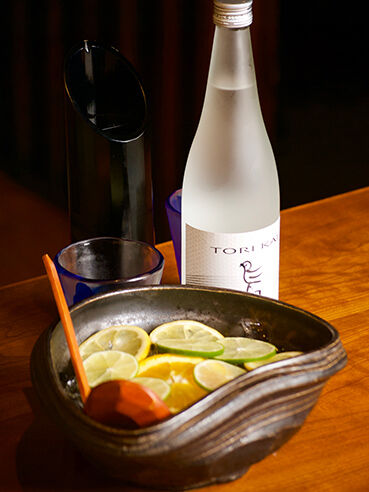
Bachiwari Service at Aburiya Kinnosuke

Not a common service style, but it had a moment in NYC a few years ago when Aburiya Kinnosuke made this a service style option. Take a punch bowl, fill it with ice, pour in a bottle of shochu, toss in some citrus rounds or other fruits or aromatics, and voila, you have a shochu punch bowl for communal service. A great way to hang out with friends!

KANPAI!

Japanese Vodka (Ep 19)

August 17, 2021 · Leave a Comment

EPISODE INTRO

In the 19th episode of the Japan Distilled podcast, your hosts Christopher Pellegrini and Stephen Lyman make brief mention of Japanese vodka.

CREDITS

Theme Song: Begin Anywhere by Tomoko Miyata (http://tomokomiyata.net/)

Mixing and Editing: Rich Pav (https://www.uncannyjapan.com/)

HOSTS

CHRISTOPHER PELLEGRINI Vermont born and bred, long-time Tokyo resident and author of The Shochu Handbook, Christopher learned about delicious fermentations as a beer brewer at Otter Creek (Middlebury, VT). He now spends most of his waking hours convincing strangers that shochu and awamori are unlike anything they’ve ever tried before. 

STEPHEN LYMAN discovered Japan’s indigenous spirits at an izakaya in New York City. He was so enthralled that he now lives in Japan and works in a tiny craft shochu distillery every autumn. His first book, The Complete Guide to Japanese Drinks, was nominated for a 2020 James Beard Award.

Stephen and Christopher spend far too much time seeking out uncommon shochu styles.

If you have any comments or questions about this episode of Japan Distilled, please reach out to Stephen or Christopher via Twitter. We would love to hear from you. 

SHOW NOTES

Friends don’t let friends drink vodka except when enjoying Russian or Slavic food and friends and culture. When exploring Japanese spirits, please explore spirits other than Japanese vodka.

Kanpai!

The Beauty of Aromatic Shochu (Ep 18)

August 2, 2021 · Leave a Comment

EPISODE INTRO

In the 18th episode of the Japan Distilled podcast, your hosts Christopher Pellegrini and Stephen Lyman turn their noses into the wonderful style that they’ve taken to calling aromatic shochu.

CREDITS

Theme Song: Begin Anywhere by Tomoko Miyata (http://tomokomiyata.net/)

Mixing and Editing: Rich Pav (https://www.uncannyjapan.com/)

HOSTS

CHRISTOPHER PELLEGRINI Vermont born and bred, long-time Tokyo resident and author of The Shochu Handbook, Christopher learned about delicious fermentations as a beer brewer at Otter Creek (Middlebury, VT). He now spends most of his waking hours convincing strangers that shochu and awamori are unlike anything they’ve ever tried before. 

STEPHEN LYMAN discovered Japan’s indigenous spirits at an izakaya in New York City. He was so enthralled that he now lives in Japan and works in a tiny craft shochu distillery every autumn. His first book, The Complete Guide to Japanese Drinks, was nominated for a 2020 James Beard Award.

Stephen and Christopher spend far too much time seeking out uncommon shochu styles.

If you have any comments or questions about this episode of Japan Distilled, please reach out to Stephen or Christopher via Twitter. We would love to hear from you. 

SHOW NOTES

Approved Aromatics

Honkaku shochu can be a confusing spirits category due to the wide breadth of ingredients that it can be made from. Unlike, for example, mezcal, which must be made with agave, authentic shochu can be made from over 50 different ingredients and that is a gross oversimplification since there are approximately 50 different potatoes that can be used as well as over 100 different rice varieties.

As we learned in previous episodes, sweet potato, barley, and rice are the most popular ingredients, comprising of between 90% and 95% of domestic sales by volume. Two other styles, kokuto sugar and soba (buckwheat) make up a lion’s share of the remaining sales volume. Everything else comprises about 1% of annual sales. That includes sake lees shochu and what we have taken to calling aromatic shochu. While some of the ingredients we consider aromatics will contribute starches or sugars to the fermentation and will raise the total alcohol production, they are primarily used for their flavor and aroma characteristics.

Without further ado, here is a complete list of the approved ingredients:

cereal grains (e.g., rice, barley, buckwheat)

tubers (e.g., sweet potatoes, potatoes)

kokuto sugar

sake lees

acorn

adzuki bean

aloe

arrowroot

ashitaba

bamboo fronds

butterbur sprout

cactus

carrots

chestnut

enoki mushrooms

gingko nuts

ginseng (multiple species)

green peas

green pepper

green tea

kelp (konbu)

leeks

lily bulbs

lotus root

matcha tea

milk

mugwort

onions

oolong tea

palm dates

peanuts

plum pits

pumpkin (kabocha)

radish

red algae (tsunomata and tsurutsuru)

safflower

saffron

seaweed

sesame seeds

shiso

shitake mushrooms

silvervine (matatabi)

skim milk

sunflower seeds

tomato

wakame seaweed

water chestnuts

water hyacinth

whey powder

No other ingredients can be used to make authentic honkaku shochu and at least for now, no more ingredients will be approved. We suspect that will be the case until there is a demand for a new ingredient. Ginger, perhaps?

Aromatic Shochu

These aromatic shochu are most often made with a rice or barley koji fermentation with more rice and/or barley added to the main fermentation. At some point during the main fermentation, the aromatic ingredient is added. This may be done from the start of the main fermentation or just a day or two before distillation depending on what aromatic profile the master brewer-distiller is hoping to achieve.

These aromatic shochu are nearly always vacuum distilled to preserve the light aromas and mute the grainy expression of the rice or barley.

What is never done is adding the aromatic to the distilled spirit. That is strictly prohibited.

AROMATIC SHOCHU MENTIONED ON THE EPISODE

BENIOTOME

Perhaps the most popular aromatic shochu overseas, Beniotome sesame shochu has a telltale roasted sesame aroma. Sweet and rich. Almost like dessert.

MIZU GREEN TEA AND MIZU LEMONGRASS

Made by Munemasa Distillery in Saga Prefecture, these aromatic expressions are simply brilliant. The lemongrass, while not an approved ingredient, is lovely and the green tea is exactly what a green tea shochu should be. Made with Ureshino Green Tea.

Mizu Green Tea (green), Lemongrass (yellow) and Barley (black) – available through Skurnik Wines.

RIHEI GINGER SHOCHU

Another non-approved expression, Rihei is a ginger shochu made by Ochiai in Miyazaki Prefecture. At 38% ABV, its clearly designed for cocktails.

Rihei

MATATABI

Silvervine (matatabi) is a relative of catnip. This vacuum distilled expression is bright and expressive and very much like a light digestif, but without any added sugars.

CHIRAN TEA CHU

A wild one. Made with both local sweet potatoes and local green tea, Chiran Tea Chu is an extremely flavorful aromatic shochu.

Makiba no Yume

A premium rice shochu with a twist – milk. Makiba no Yume carries a nice lactic finish and is beautiful with bubbles.

DABADA

Chestnut shochu is primarily made on the island of Shikoku, just to the northeast of Kyushu. This is a very popular brand in Japan and can sometimes be found overseas.

dababa aromatic shochu

Do you have a favorite aromatic shochu not mentioned on the show? Please let us know!

Kanpai!

Environmentally Responsible Kasutori Shochu (ep. 17)

July 19, 2021 · Leave a Comment

EPISODE INTRO

In the 17th episode of the Japan Distilled podcast, your hosts Christopher Pellegrini and Stephen Lyman take a look at an environmentally and historically important, but uncommon style of shochu. That is kasutori shochu made from the sake lees, or the solids remaining after sake production.

CREDITS

Theme Song: Begin Anywhere by Tomoko Miyata (http://tomokomiyata.net/)

Mixing and Editing: Rich Pav (https://www.uncannyjapan.com/)

HOSTS

CHRISTOPHER PELLEGRINI Vermont born and bred, long-time Tokyo resident and author of The Shochu Handbook, Christopher learned about delicious fermentations as a beer brewer at Otter Creek (Middlebury, VT). He now spends most of his waking hours convincing strangers that shochu and awamori are unlike anything they’ve ever tried before. 

STEPHEN LYMAN discovered Japan’s indigenous spirits at an izakaya in New York City. He was so enthralled that he now lives in Japan and works in a tiny craft shochu distillery every autumn. His first book, The Complete Guide to Japanese Drinks, was nominated for a 2020 James Beard Award.

Stephen and Christopher both have their sake certifications, but spend almost all of their time thinking about spirits instead.

If you have any comments or questions about this episode of Japan Distilled, please reach out to Stephen or Christopher via Twitter. We would love to hear from you. 

SHOW NOTES

Sake Lees

As you may remember from episode 10, there are clear differences between sake and shochu even though both are native to Japan and both use koji for saccharification. The finished sake fermentation is pressed to extract the alcoholic beverage and the solids that remain are predominantly rice that was not completely dissolved during the fermentation.

These lees have high nutritional value and can be used as fertilizer. However, the lees contain residual alcohol that would be damaging to soil and the root systems of crops. As such, the alcohol needs to be removed prior to use as fertilizer.

Sake Lees Shochu

Fortunately, the residual alcohol can be extracted through distillation. This is most often done today by rehydrating the lees with additional water. Some sake breweries will restart the fermentation at this point adding fresh rice koji and yeast to the rehydrated lees. This creates a fresher, brighter kasutori shochu.

An old style kasutori shochu is known as sanaburi shochu, which was traditionally made at rice harvest festivals. The farmers would bring their rice to town to get it polished and the sake brewers would bring out their lees. The lees and rice bran would be mixed and distilled in an old seiryo mushi, or wooden steam still.

A seiryo mushi being used to make sanaburi shochu at Morinokura in Fukoka Prefecture.

These unctuous styles require long term aging. In fact, Morinokura ages their sanaburi shochu for 13 years before bottling.

The Dou Kabuto Vertical (all bottled at 13 years old)

OTHER KASUTORI SHOCHU MENTIONED ON THE EPISODE

DASSAI

Dassai Shochu (top right) alongside Dassai 45.

Dassai has taken the sake world by storm with their simple, elegant packaging and simplified numbering system replacing the complicated premium sake labeling standards. They’ve now begun making kasutori shochu in high enough quantities to start selling outside of Yamaguchi Prefecture where Dassai is made. For a long time you could only get the bottles at the brewery or nearby sake shops.

HAKKAISAN

A selection of kasutori shcohu from Hakkaisan Brewery in Niigata.

Hakkaisan in northern Niigata Prefecture makes some beautiful sake and as one of the largest sake producers in the prefecture they have plenty of sake lees to bring out a variety of kasutori shochu. Timothy Sullivan of UrbanSake.com and the Sake Revolution Podcast spent a year working at Hakkaisan. He has wealth of knowledge about sake in general and the Niigata region where Hakkaisan is made.

KINPEIBAI

kasutori shochu
Kinpeibai 35% ABV Kasutori Shochu

This uncommon 35% alcohol kasutori shochu is made in Saga Prefecture by Gochida Brewery. The high alcohol makes for a rich mouthfeel and the label is resolutely targeting Chinese tourists as its named after a popular erotic novel in China.

NIHON NO KOKORO

Nihon no Kokoro Kasutori Shochu

The only kasutori shochu we can confirm has US distribution is Nihon no Kokoro from Kitaya Berwery and Distillery in Yame, Fukuoka. This excellent example is made from daiginjo sake lees and aged for 5 years after vacuum distillation.

SHIGEMASU

Shigemasu Kasutori Shochu has beautiful packaging that’s not easy to photograph.

As we mentioned on the show, there are not many kasutori shochu available with wide distribution so we do not have too many brands to specifically recommend.

Kanpai!

Jumping into Japanese Gin (ep. 16)

July 5, 2021 · Leave a Comment

EPISODE INTRO

In the 16th episode of the Japan Distilled podcast, your hosts Christopher Pellegrini and Stephen Lyman take a closer look at Japanese gin. While gin was first made in Japan over 200 years ago, it has really only taken root in the past few years.

CREDITS

Theme Song: Begin Anywhere by Tomoko Miyata (http://tomokomiyata.net/)

Mixing and Editing: Rich Pav (https://www.uncannyjapan.com/)

HOSTS

CHRISTOPHER PELLEGRINI Vermont born and bred, long-time Tokyo resident and author of The Shochu Handbook, Christopher learned about delicious fermentations as a beer brewer at Otter Creek (Middlebury, VT). He now spends most of his waking hours convincing strangers that shochu and awamori are unlike anything they’ve ever tried before. 

STEPHEN LYMAN discovered Japan’s indigenous spirits at an izakaya in New York City. He was so enthralled that he now lives in Japan and works in a tiny craft shochu distillery every autumn. His first book, The Complete Guide to Japanese Drinks, was nominated for a 2020 James Beard Award.

Stephen and Christopher both prefer their martinis up and very dry.

If you have any comments or questions about this episode of Japan Distilled, please reach out to Stephen or Christopher via Twitter. We would love to hear from you. 

LINKS

Time Out Tokyo’s Best Japanese Gins List

Punch Drink’s Essential Japanese Gins List

SHOW NOTES

Gin Origins

The earliest known use of juniper in distilled alcohols was from Italian monks who steeped juniper berries in wine before distillation for a tincture. The Dutch were the first to make a juniper spirit with genever, which was a malted grain spirit infused with juniper berries and other botanicals. Genever was first enjoyed by the English in the Thirty Years War and a few decades later England began making their own genever, which was quickly anglicized to gin.

The introduction of the Coffey Still in 1830 quickly gave rise to London Dry Gin, which is the predominant style even to this day.

Japanese Gin

The Dutch were importing genever to Dejima Port in Nagasaki for their own enjoyment and in 1812 what is believed to be the first Japanese produced gin was made by a Japanese bureaucrat who was trying to keep the Dutch traders happy when a naval blockade prevented the delivery of their genever shipment.

However, the first dedicated gin distillery was not opened in Japan until 2015 when the Kyoto Distillery began operations. They released Kinobi Gin in 2016 and the Japanese gin wave began. By 2017 both Suntory and Nikka had released their own gins and today there are dozens of Japanese gins made throughout the country, but perhaps unsurprisingly, most often in Kyushu where over 300 shochu distilleries are located.

JAPANESE GINS MENTIONED ON THE EPISODE

KINOBI

Kinboi Japanese Gin
Kinobi Japanese Gin

Kinobi Kyoto Dry Gin is really the OG of Japanese gins. It’s extremely well made at the dedicated Kyoto Distillery.

NIKKA COFFEY GIN

Nikka Coffey Gin

Nikka’s coffey still made gin is quite well regarded, though in pretty minimalist packaging. In true Nikka fashion, the gin does the talking.

ROKU GIN

Suntory, as usual, goes with the flashy packaging packed with meaning. Roku means 6 in Japanese for the 6 botanicals (one of which is cherry blossoms in case the picture wasn’t obvious enough). The bottle also has 6 sides. Clever marketing from the world’s largest spirits maker.

YUZU GIN

Yuzu Gin from Kyoya Distillery

Yuzugin from Kyoya Distillery in Miyazaki may have been the first gin made by a shochu maker, at least in recent memory. It did not take long for others to join the wave.

KOMASA GIN

Komasa Gin

Komasa, one of Kagoshima’s largest shochu producers, and the maker of the newly released Kanosuke Malt Whisky, has now released 3 different gins. The original is made with local komikan citrus, the 2nd with green tea, and the 3rd with strawberries.

424 GIN

424 Gin

Wakashio Distillery in Kagoshima zigged when others zagged. Their 424 Gin is only made with juniper rather than the pervasive Japanese citrus approach.

JIN 40

Jin 40 Asakura Craft Gin

The Shinozaki Distillery in Fukuoka used local lemongrass as the predominant botanical in Jin 40, their first experiment in the gin world. It will not be their last.

SAKURAO GIN

Sakurao has 2 different gin expressions. The pink “limited” bottle has oyster shells in the mashbill! Please see Whisky Richard’s review on Nomunication.jp for much more info.

DENNOSHIN 1812 EXTREME JUNIPER GIN

Dennoshin 1812 Extreme Juniper Gin

Dennoshin 1812 was the revival of a genever made in 1812 by a local government bureaucrat to amuse the Dutch stationed at Dejima in Nagasaki. They claim 3x the usual juniper quantity in the mash bill. It is made palatable with the addition of sugar after distillation as is sometimes done in genever or Old Tom Gin.

OSUZU GIN

Osuzu Gin

And last but not least, Stephen’s current favorite Japanese gin, Osuzu from Osuzuyama Distillery. Whisky Richard’s review is a must read on this original relase from this well regarded distillery.

If we missed anything, please let us know, but this should keep you busy for a while.

Kanpai!

  • « Go to Previous Page
  • Page 1
  • Interim pages omitted …
  • Page 14
  • Page 15
  • Page 16
  • Page 17
  • Page 18
  • Page 19
  • Go to Next Page »

Primary Sidebar

Never miss a new episode. Subscribe now

Japan Distilled

Copyright © 2026 · Log in